
Manvantaras
Manvantara · manu-antara, “the age of a Manu”
Kalpa has other meanings too: see all meanings of Kalpa. Citrasena has other meanings too: see all meanings of Citrasena. Ṛshabha has other meanings too: see all meanings of Ṛshabha. Manu has other meanings too: see all meanings of Manu. Vidūratha has other meanings too: see all meanings of Vidūratha.
A manvantara is one of the fourteen great ages that make up one Kalpa, a single day of Brahmā. Each has its own Manu, the father and ruler of humankind for that age, with his own Indra, his own classes of devas, his own saptarshis (seven ṛshis) and royal sons who protect the earth; all of them arise anew with the manvantara and pass away at its end. Mārkaṇḍeya Maharshi tells all fourteen to his disciple Kraushṭuki in Chapters 58–98 of the Mārkaṇḍeya Purāṇa, one of the eighteen Purāṇas. It does not merely list the Manus and their ages but tells how many of the Manus came to be, in stories woven of dharma, karma and tapas. One manvantara is seventy-one Mahāyugas and a little more, about thirty crore sixty-seven lakh and twenty thousand human years; six have passed, the seventh, that of Vaivasvata Manu, is going on now, and seven are still to come. At the end of the fourteenth the day of Brahmā closes in pralaya. Each manvantara below, and each person of their accounts, has its own full page; here each is given in short, with a link to it.
The Agni Purāṇa (Chapter 150) gives its own list, told by Agni-deva: for each manvantara the Manu, his sons, the devas, the saptarshis and the Indra, with the aṃśāvatāras in which Śrī Mahāvishṇu descended in the first seven, from Mānasa in the Svāyambhuva to Vāmana in the Vaivasvata. In every manvantara the saptarshis spread the Veda on the earth, the devas receive their share and the sons of Manu rule, and at the end of each Dvāpara Bhagavān Vishṇu descends as Vedavyāsa to divide the Veda. At a king’s abhisheka the purohita calls on the fourteen Manus, by name, to protect him (Chapter 219). The Vāmana Purāṇa (Chapter 46) tells how seven Maruts were born in each of the first six manvantaras, and its Saro Māhātmya says that gifts and śrāddhas at the Jyeshṭhāśrama in the Vāmana kshetra, and tarpaṇa with black sesame at the Sthāṇu liṅga in Kurukshetra, bear fruit to the end of the manvantara.
In the Bhāgavata Purāṇa, Śuka Maharshi tells all fourteen manvantaras to Parīkshit in Skandha 8 (Chapters 1, 5, 13 and 14), and for each he names the Manu, the Manu’s sons, the devas, the Indra, the saptarshis and the aṃśāvatāra of Śrī Hari who protects that age, from Yajña in the first and Vāmana in the present seventh to Bṛhadbhānu in the fourteenth. All of them, Śuka says, work under the command of the Purushottama alone. The Bhāgavata counts the manvantaras among the ten subjects of a Mahāpurāṇa; its teaching is given below, after the other accounts.
Mārkaṇḍeya closes with the phalaśruti: one who hears the manvantaras in order gains merit and his line never fails. Each brings its own fruit, from dharma for the first to the grace of the devas and good sons for the fourteenth. One who hears of their devas, ṛshis, Manus and kings is freed from all pāpas; the rulers of those ages, pleased, bestow a good intellect, the seasons bring welfare and the planets stay gentle.
The Bhavishya Purāṇa gives the measure of a manvantara and the names of the fourteen Manus and the fourteen Indras. Sumantu teaches them to King Śatānīka in the Brahma Parva, and the Uttara Parva measures the phala of many vratas and dānas in manvantaras, up to a hundred of them spent in the higher lokas.
The Brahma Purāṇa tells the manvantaras in its fifth chapter, the Manvantara-kīrtana, and gives the life-span of a Manu as seventy-one mahāyugas.
In the Brahma Vaivarta Purāṇa, seventy-one divine yugas make a manvantara, an Indra lives as long as a Manu, and when fourteen Indras have passed it is one day of Brahmā. The brāhmaṇa Sutapā tells King Suyajña the fourteen Manus as Bhagavān Śiva told them to him, from Svāyambhuva, the son of Brahmā, to Candrasāvarṇi, and says that all of them were dharmic jñānīs who worshipped Śrī Kṛshṇa. The Purāṇa sees every Manu as an aṃśa of an aṃśa of Śrī Kṛshṇa: half a kshaṇa in Goloka is a manvantara on earth, and the life of Brahmā is a blink of his eye. Here too the phala of holy acts and the stay in the narakas are measured in manvantaras.
The past and present manvantaras
Svāyambhuva Manvantara
The Svāyambhuva Manvantara is the first of the fourteen manvantaras. At the dawn of creation Brahmā took a body half male and half female: the male half became Svāyambhuva Manu and the female half Śatarūpā, his wife. Their sons were Priyavrata and Uttānapāda, and their daughters Ākūti and Prasūti, with Devahūti as a third in the Bhāgavata Purāṇa. Priyavrata divided the earth into seven dvīpas among his sons, from Āgnīdhra in Jambū-dvīpa to Savana in Pushkara-dvīpa; from Āgnīdhra’s son Nābhi came Ṛshabhadeva, and from him Bharata, after whom Bhārata-varsha is named. Uttānapāda’s son Uttama became the third Manu.
The Bhāgavata Purāṇa tells how the families of all the worlds spread from Manu’s daughters. Ākūti and Ruci Prajāpati had Yajña, Bhagavān Vishṇu himself, and Dakshiṇā; Yajña was Indra of this age and their twelve sons, the Tushitas, its devas. Devahūti married Kardama and was the mother of Bhagavān Kapila, and Kardama’s nine daughters married the great brahmarshis. Prasūti married Daksha, and from Dharma’s wife Mūrti were born Nara and Nārāyaṇa. The Brahmāṇḍa Purāṇa adds the nine mind-born sons of Brahmā, the teaching that karma carries on from kalpa to kalpa, and the debate on yajña in which King Vasu was swallowed into Rasātala.
In the Agni Purāṇa the Yāmas are the devas of this age, Aurva and the others the saptarshis, Śatakratu the Indra, and Bhagavān Vishṇu descended as the aṃśāvatāra Mānasa. The Vishṇu Dharmottara Purāṇa names Viśvadhṛk as Indra and tells that Bhagavān Vishṇu came on Garuḍa to destroy the daitya Keśibaya. The Vāmana Purāṇa tells of the first Maruts: Savana’s wife Sudevā entered the fire with him, he rose with her into the sky, and his seed, drunk by the wives of the Saptarshis, became seven sons whom Brahmā named the Maruts.
Per Bhāgavata Purāṇa (Skandha 8, Chapter 1), Śrī Hari was born in this manvantara as a son in Manu’s daughters Ākūti and Devahūti, as Kapila and as Yajña. Svāyambhuva Manu gave up his kingdom and performed tapas on the bank of the Sunandā, and when asuras and rākshasas rushed at him, Śrī Hari as Yajña, with the devas called the Yāmas, slew them and himself became Indra. Maitreya tells Vidura that Yajña’s twelve sons were the Tushita devas of this age (Skandha 4, Chapter 1). The whole account is on the Svāyambhuva Manvantara page.
Svārocisha Manvantara
The Svārocisha Manvantara is the second manvantara of the present kalpa, named after its Manu, Svārocisha Dyutimat. Mārkaṇḍeya tells its long account to Kraushṭuki. The brāhmaṇa Pravara of Aruṇāspada flew to Himavat by a magic ointment, which the snow washed away. The apsarā Varūthinī loved him, but he refused her, saying he desired only his sacred fires and his own wife, and the Gārhapatya fire carried him home. The Gandharva Kali then took Pravara’s form, and Varūthinī bore him a son, Svarocis, who shone with his own light.
Svarocis saved the Vidyādharī Manoramā from a rākshasa, who was her own father Indīvara under a ṛshi’s śāpa, and was given the whole Āyurveda. He healed her friends Vibhāvarī and Kalāvatī and married all three, gaining the speech of all beings and the jñāna named Padminī, and his three sons ruled from three cities. Rebuked by birds and a buck for his life of pleasure, he at last embraced a doe who became the devī of the forest, and their son Dyutimat, named Svārocisha, became Manu. Svarocis then left with his wives for tapas and reached the pure worlds.
In this manvantara the Pārāvatas and Tushitas were the devas, Vipaścit was Indra, and Ūrja, Stamba, Prāṇa, Dattoli, Ṛshabha, Niścara and Carvavīra were the saptarshis; Caitra and Kimpurusha were among Manu’s sons. One who hears it with śraddhā is freed from pāpa. Its full page also gives the accounts of the Vāyu and Brahmāṇḍa Purāṇas (the twenty-four soma-drinking Tushita and Pārāvata devas, the saptarshis by family, and the four pillars of every manvantara), the Vāmana Purāṇa‘s birth of the Maruts from the seed of the sons of Kratudhvaja, and the Agni Purāṇa‘s word that Bhagavān Vishṇu descended in this age as Ajita. The people of this account have their own pages under the Svārocisha Manvantara.
Per Bhāgavata Purāṇa (Skandha 8, Chapter 1), Svārocisha, the second Manu, was the son of Agni, and Rocana was his Indra. Śrī Hari was born to the maharshi Vedaśiras and Tushitā as Vibhu, a lifelong brahmacārī whose vrata eighty-eight thousand maharshis kept.
Uttama Manvantara
The Uttama Manvantara is the third manvantara, the same age the Mārkaṇḍeya Purāṇa also calls Auttara or Auttama. Here its Manu is Uttama, son of Uttānapāda and grandson of Svāyambhuva Manu. In brief, his queen Bahulā, cold toward him and sent away, was carried to Rasātala by the nāga king Kapotaka and brought back by a brāhmaṇa’s yajña, after which their love was fully restored.
Its devas were five groups, the Svadāmas, Satyas, Śivas, Pratardanas and Vaśavartins, Suśānti was Indra, and Aja, Paraśuci and Divya were among the royal sons. The Kūrma, Brahmāṇḍa and Vāyu Purāṇas agree on Suśānti as Indra and give the sixty devas and the thirteen sons of Manu by name; in the Brahmāṇḍa the saptarshis are the seven sons of Vasishṭha. The Vishṇu Dharmottara Purāṇa names Śuciśrī as Indra and tells that Bhagavān Vishṇu came as the Matsya avatāra to protect this age from the daitya Pralamba.
The Vāmana Purāṇa tells of the Maruts of this age: the saptarshis promised seven sons to Jyotishmān of Nishadha and his wife, who were performing tapas on the Mandākinī. The king died while she was with child, and when she entered his pyre, a lump of flesh fell from her womb into the water and became the seven Maruts. In the Agni Purāṇa, Bhagavān Vishṇu descended in this age as the aṃśāvatāra Satya.
Per Bhāgavata Purāṇa (Skandha 8, Chapter 1), Uttama, the third Manu, was the son of Priyavrata, and Satyajit was his Indra. Śrī Hari was born to Dharma in Sūnṛtā as Satyasena, befriended Satyajit and slew the yakshas, rākshasas and bhūtas that harmed living beings.
Auttama Manvantara
The Auttama Manvantara, also called the Uttama Manvantara, is the third manvantara, as Mārkaṇḍeya tells it in the Mārkaṇḍeya Purāṇa. Its Manu, Auttama, was the son of King Uttama, son of Uttānapāda. Uttama loved his queen Bahuḷā wholly, but she gave him no affection, and when she turned away from his cup in the open court he had her left in a lonely forest.
A brāhmaṇa named Viśāla then came to the king: an unknown being had carried off his harsh and unlovely wife, and he asked the king, who takes a sixth of his people’s earnings, to protect him. The king refused to let him take another wife, set out to find her, and at a ṛshi’s āśrama was refused arghya, for in casting out his own wife he had given up the dharmas that depend on her. The rākshasa Balāka, who fed on natures and not on flesh, had taken the woman to stop Viśāla’s rakshoghna mantras at yajñas. At the king’s command Balāka ate her harsh nature and brought her home.
The ṛshi told the king that Bahuḷā lived in Pātāla under the shelter of the Nāga princess Nandā, whom her father Kapotaka had made mugdhā, bereft of awareness, by his śāpa for refusing to give Bahuḷā up. Viśāla performed the Mātṛvandā ishṭi seven times, and Bahuḷā’s heart turned to her husband; Balāka brought her back, and a Sārasvatī ishṭi freed Nandā, who blessed the king with a son who would be Manu. That son, radiant as the full moon, was named Auttama. In his age there were five gaṇas of twelve devas each, Suśānti of a hundred aśvamedhas was Indra, the seven sons of Vasishṭha were the saptarshis, and his sons were Aja, Paraśu and Divya. Whoever hears this account, Mārkaṇḍeya says, never meets enmity or sorrow, nor separation from those dear to him.
Tāmasa Manvantara
The Tāmasa Manvantara is the fourth manvantara, told by Mārkaṇḍeya to Kraushṭuki in Chapter 71 of the Mārkaṇḍeya Purāṇa. King Svarāshṭra, a performer of many yajñas, received a long life as a vara from Bhagavān Sūrya, but outlived his sons, wives and ministers, gave his kingdom to Vīmarda and went to the forest for tapas. Swept away by a flood in total darkness, he held on to a doe, who spoke in a human voice: she was Utpalavati, who in a past birth had parted a mating pair of deer, one of them the Ṛshi Sutapa, and received his śāpa to be born a doe until she bore a son who would be Manu.
The son born of that doe, in an age of darkness, was named Tāmasa by the ṛshis. He worshipped Bhagavān Sūrya, received divine astras, defeated his father’s enemies and freed them at his father’s word, and became the fourth Manu. In his age the Satya, Sudhī, Sarpa and Hari gaṇas, twenty-seven devas each, were the devas, Śikhi of a hundred yajñas was Indra, Jyotirdhāma, Pṛthu, Kavya, Caitra, Agni, Balāka and Pivara were the saptarshis, and Nara, Kānta, Śānta, Dānta and others were Manu’s sons. One who hears the account is never bound by ajñāna.
The Vāmana Purāṇa names Tāmasa as the brother of Uttama and tells how the Maruts of this age came forth from the fire into which his son Ṛtudhvaja offered his own body. In the Agni Purāṇa, Bhagavān Vishṇu descended in this age as the aṃśāvatāra Hari.
Per Bhāgavata Purāṇa (Skandha 8, Chapter 1), Tāmasa, the fourth Manu, was the brother of Uttama, and Triśikha was his Indra; the Vaidhṛtis of this age protected the Vedas lost through time. Śrī Hari was born to Harimedhas and Hariṇī as Hari and freed Gajendra from the crocodile (Skandha 8, Chapters 2–4).
Raivata Manvantara
The Raivata Manvantara is the fifth manvantara, told in Chapter 72 of the Mārkaṇḍeya Purāṇa. The Ṛshi Ṛtavāc had a son born at the very end of the Revatī nakshatra, who grew up without good character and carried off another muni’s son’s wife. When Garga told him that the hour of birth alone was the cause, Ṛtavāc in his anger made the Revatī nakshatra fall from the sky. It fell on the Kumuda mountain, which from then was called Raivataka.
From a lotus lake, through the tejas of the fallen star, a maiden was born. The muni Pramuca named her Revatī and raised her, and Agni told him that King Durgama, of the line of Priyavrata, would be her husband. When Durgama came hunting and called her “Beloved”, Pramuca honoured him as the son-in-law Agni had foretold. Revatī asked to be married only under her own nakshatra, so Pramuca by the power of his tapas set Revatī back on the path of the moon. He married her to Durgama, and granted the king’s one prayer: a son who would be lord of a manvantara.
That son was Raivata Manu, unconquered by the knowers of dharma and master of the Veda and the śāstras. In his age the Sumedhās, Bhūtapatis, Vaikuṇṭhas and Amitābhas were the devas, fourteen in each group, under Vibhu, the Indra of a hundred yajñas. The saptarshis were Hiraṇyaloman, Vedaśrī, Ūrdhvabāhu, Vedabāhu, Sudhāman, Parjanya and Vasishṭha, and Balabandhu, Suyashṭavya and Satyaka were among his sons.
The Vāmana Purāṇa tells that the Maruts of this age rose from the pyre of Surati, the daughter King Ripujit of Raivata’s line received from Bhāskara. The Agni Purāṇa names Vitatha as Indra, the Amitābhas as devas and Ailabandha and the others as Manu’s sons, and says that Bhagavān Vishṇu descended in this age as the aṃśāvatāra Devavara.
Per Bhāgavata Purāṇa (Skandha 8, Chapter 5), Raivata, the fifth Manu, was the brother of Tāmasa, and Vibhu was his Indra. Śrī Hari was born to the ṛshi Śubhra and Vikuṇṭhā as Vaikuṇṭha, and at the prayer of Lakshmī Devī he created the loka called Vaikuṇṭha.
Cākshusha Manvantara
The Cākshusha Manvantara is the sixth manvantara, told by Mārkaṇḍeya in Chapter 73 of the Mārkaṇḍeya Purāṇa. In a former birth its Manu had been born from the eyes of Prajāpati Brahmā, and so the name Cākshusha stayed with him. Born again as the son of the Rājarshi Anamitra and Bhadrā, he remembered his past lives, and laughed on his mother’s lap: the cat and the Jātahāriṇī, the stealer of newborns, watched him for their own ends, and so, he said, did her love.
When his mother left him, the Jātahāriṇī put him in the bed of King Vikrānta’s queen Haiminī, carried her son Caitra to the house of the brāhmaṇa Bodha in Viśāla village, and ate Bodha’s own child. Raised as the prince Ānanda, the boy asked at his upanayana to which mother he should bow, told the whole truth, and taught that in saṃsāra no one truly belongs to anyone. Caitra was brought back to the throne, and Ānanda went to the forest for tapas.
Brahmā appeared and told him that mukti comes only when one’s karma is spent: he must first serve as the sixth Manu. Called by his true name Cākshusha, he married Vidarbhā, daughter of King Ugra, and his sons Uru, Pūru, Śatadyumna and others ruled the earth. In his age the devas were the Āpyas, Prasūtas, Bhavyas, Yūthakas and others, eight in each group, with the Lekhas; Manojava of a hundred yajñas was Indra; and Sumedhā, Viraja, Havishmat, Unnata, Madhu, Atināman and Sahishṇu were the saptarshis. Whoever glorifies or hears this account with devotion gains sons, health, happiness and wealth.
The Vāmana Purāṇa tells that the Maruts of this age were born at the Saptasārasvata tīrtha, from the seed of the tapasvī Maṅkaṇaka, when the Tushita devas sent Vapu to break his tapas. The Agni Purāṇa places this Manu in the line of Dhruva, the son of Cākshusha and grandson of Ripu, and says that in his manvantara Bhagavān Vishṇu descended as the aṃśāvatāra Vaikuṇṭha.
Per Bhāgavata Purāṇa (Skandha 8, Chapter 5), Cākshusha, the sixth Manu, was the son of Cakshu, and Mantradruma was his Indra. Śrī Hari was born to Vairāja in Sambhūti as Ajita, churned the ocean for the devas’ amṛta and as the tortoise held up Mount Mandara (Skandha 8, Chapters 5–12); at the end of this manvantara he took the form of Matsya and saved Vaivasvata Manu (Skandha 1, Chapter 3).
Vaivasvata Manvantara
The Vaivasvata Manvantara is the seventh manvantara, the one now going on. Its Manu, Vaivasvata, is the son of Vivasvān (Sūrya) and Saṃjñā Devī, the daughter of Viśvakarmā. The Mārkaṇḍeya Purāṇa tells how Saṃjñā, unable to bear Sūrya’s tejas, left her shadow Chāyā in her place and performed tapas in Uttara Kuru as a mare; how Chāyā‘s śāpa on Yama brought the truth to light; how Viśvakarmā reduced Sūrya’s tejas as the devatās praised him in a stotra, and made divine weapons from it; and how Sūrya, reunited with Saṃjñā, gave each of his children a place, with Vaivasvata as Manu.
In this age the devas are eight groups, the Ādityas, Vasus, Rudras, Sādhyas, Viśvedevas, Maruts, Bhṛgus and Aṅgirases. The Mārkaṇḍeya Purāṇa names Ūrjasvī as Indra, and the saptarshis are Atri, Vasishṭha, Kaśyapa, Gautama, Bharadvāja, Viśvāmitra and Jamadagni. Vaivasvata’s nine sons are Ikshvāku, Nābhaga, Dhṛshṭa, Śaryāti, Narishyanta, Nābhāga, Dishṭa, Karūsha and Pṛshadhra. Those who hear or read this account are released from pāpa.
In the Vāmana Purāṇa Bhagavān Vishṇu tells Bali that after this Vaivasvata manvantara he will be Indra in the Sāvarṇi. The Agni Purāṇa names the Manu Śrāddhadeva, gives Purandara as Indra, says that Bhagavān Vishṇu descended in this age as Vāmana, and tells that the Tushita devas of the Cākshusha age were born again to Kaśyapa and Aditi as the twelve Ādityas.
Per Bhāgavata Purāṇa (Skandha 8, Chapter 13), the present seventh Manu is Śrāddhadeva, the son of Sūrya-deva, with ten sons headed by Ikshvāku; Purandara is Indra, and Bhagavān Vishṇu was born to Kaśyapa from Aditi as Vāmana. In the past kalpa this Manu was the rājarshi Satyavrata, whom Bhagavān Matsya saved in the pralaya (Skandha 8, Chapter 24).
The manvantaras to come
Sāvarṇi Manvantara
The Sāvarṇi Manvantara is the eighth manvantara, and the first of those still to come. Its Manu is Sāvarṇi, son of Sūrya by Chāyā, the shadow-form Saṃjñā made to take her place, and so the younger half-brother of Vaivasvata Manu. The Agni Purāṇa explains the name: his varṇa, the colour of his body, is the same as his elder brother Śrāddhadeva’s, so he is Sāvarṇi, “of the same colour”.
Its Indra will be Bali Cakravartī, son of Virocana and grandson of Prahlāda, who gave the three worlds to Bhagavān Vāmana and was given Sutala. The Bhāgavata Purāṇa tells it as Bhagavān Śrī Hari’s own promise, and the Vāmana Purāṇa gives Bhagavān Vishṇu‘s word twice: once to Bali‘s son Bāṇa, and once to Bali himself, that for the dāna-water poured into his hand Bali has a life of a kalpa and will be Indra after the present manvantara. In this age Bhagavān Śrī Hari will be born to Devaguhya and Sarasvatī as Sārvabhauma, and will take the rule of svarga from Purandara and give it to Bali.
Its devas are the Sutapas, Virajas and Amṛtaprabhas, and its saptarshis are Gālava, Dīptimān, Paraśurāma, Aśvatthāmā, Kṛpācārya, Ṛshyaśṛṅga and Bādarāyaṇa Vyāsa, who, the Bhāgavata says, live even now in their āśramas by the power of yoga. The Vishṇu Dharmottara Purāṇa also names Bali as Indra, and tells that Bhagavān Vishṇu will come on Garuḍa with the Sudarśana cakra to destroy the daitya Sagunānala and set up Bali’s rule.
Per Bhāgavata Purāṇa (Skandha 8, Chapter 13), the eighth Manu will be Sāvarṇi, the eldest son of Sūrya by Chāyā, and his Indra will be Bali, son of Virocana, who now dwells in Sutala by Śrī Hari’s vara (Skandha 8, Chapter 22); Bādarāyaṇa Vyāsa, Śuka‘s father, will be among its saptarshis.
Sūrya Sāvarṇi Manvantara
The Sūrya Sāvarṇi Manvantara is the eighth manvantara as Mārkaṇḍeya tells it in Chapters 74–77 of the Mārkaṇḍeya Purāṇa, with the account of its Manu‘s birth. Saṃjñā, the daughter of Viśvakarmā and wife of Sūrya, bore Vaivasvata Manu, Yama and Yamunā, but could not bear her husband’s tejas. She made from her own body a shadow-form, Chāyā, to stay in her place, went to her father, and then to Uttara Kuru, where she performed tapas in the form of a mare.
Taking Chāyā for Saṃjñā, Sūrya had by her two sons, Sāvarṇi and Śanaiścara, and a daughter, Tapatī. When Chāyā gave Yama a śāpa for lifting his foot at her, the truth came out. Viśvakarmā reduced Sūrya’s tejas as the devatās praised him as the Ṛk, Yajus and Sāma, and from the parts taken away he made the śūla of Mahādeva, the cakra of Vishṇu and other divine weapons. Sūrya went to Saṃjñā as a horse, and the Aśvinī-kumāras and Revanta were born. Sūrya gave each child his place: Vaivasvata as Manu, Yama in his office, Yamunā as a river, the Aśvins as physicians of svarga, Śanaiścara among the grahas, and Sāvarṇi as the Manu to come when Bali becomes Indra.
In that age the devas are the Sutapas, Amitābhas and Mukhyas, twenty in each gaṇa, all offspring of Kaśyapa; Bali, son of Virocana, who even now dwells in Pātāla bound by his promise, is Indra; Rāma, Vyāsa, Gālava, Dīptimān, Kṛpa, Ṛshyaśṛṅga and Aśvatthāmā are the saptarshis; and Viraja, Arvavīra, Nirmoha and others are the kings.
Daksha Sāvarṇi Manvantara
The Daksha Sāvarṇi Manvantara is the ninth manvantara, which Mārkaṇḍeya describes after the Sūrya Sāvarṇika Manvantara and the Devī Māhātmya. It lies in the future, and its Manu is Sāvarṇi, a son of Daksha.
Its devas form three gaṇas of twelve each, the Pārās, the Mārīcibhargas and the Sudharmās. The mighty Sahasrāksha holds the throne of Indra: Mārkaṇḍeya reveals that the one now known as Kārtikeya, the six-faced son of Agni, will be the Indra named Adbhuta in that age. The saptarshis are Medhātithi, Vasu, Satya, Jyotishmān, Dyutimān, Sabala and Havyavāhana, and the sons of Manu who will rule are Dhṛshṭaketu, Barhaketu, Hasta, Nirāmaya, Pṛthuśravas, Arcishmān, Bhūridyumṇa, Bṛhadbhaya and others. The Agni Purāṇa gives Pāra and the others as devas, Adbhuta as Indra, Savana and the others as saptarshis, and Dhṛtaketu as the son of Manu.
Per Bhāgavata Purāṇa (Skandha 8, Chapter 13), the ninth Manu, Dakshasāvarṇi, will be the son of Varuṇa, and Adbhuta will be Indra; Śrī Hari will be born to Āyushmat by Ambudhārā as Ṛshabha, win the three worlds and give them to Adbhuta.
Brahma Sāvarṇi Manvantara
The Brahma Sāvarṇi Manvantara is the tenth manvantara, which Mārkaṇḍeya describes after that of Daksha Sāvarṇi. Its Manu is a son of Brahmā himself. Its devas are of two groups, the Sukhāsīnas and the Aniruddhas, a hundred in all, for in this age the number of beings is a hundred and the devas match it.
Śānti, endowed with every quality of the office, is Indra. The saptarshis are Āpomūrti, Havishmān, Sukṛtī, Satya, Nābhāga, Apratima and Vasishṭha, and the sons of Manu who rule the earth are Sukshetra, Uttamaujas, Bhūrisheṇa, Vīryavān, Śatānīka, Vṛshabha, Anamitra, Jayadratha, Bhūridyumṇa and Suparva. The Agni Purāṇa gives the same age in brief: the Sukhas and the others as devas, Śānti as Indra, Havishya and the others as saptarshis, and Sukshetra and the others as Manu’s sons.
Per Bhāgavata Purāṇa (Skandha 8, Chapter 13), the tenth Manu, Brahmasāvarṇi, will be the son of Upaśloka, and Śambhu will be Devendra; Śrī Hari will be born to Viśvasṛj and Vishūci as Vishvaksena, the friend of Śambhu.
Dharmasāvarṇi Manvantara
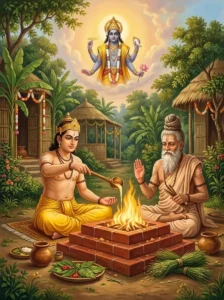
The Dharmasāvarṇi Manvantara is the eleventh of the fourteen manvantaras, and it lies in the future. In the account of the Bhāgavata Purāṇa its Manu is Dharmasāvarṇi, a master of his senses, whose sons include Satyadharma and Kshemadhanvā. Vaidhṛta is Indra, the devas include the Vihaṅgamas, the Kāmagamas and the Nirvāṇarucis, and Aruṇa and Havishmān are among the saptarshis. In this age Bhagavān Śrī Hari will be born to Āryaka and Vaidhṛtā as Dharmasetu and will protect the three worlds. Dharmasāvarṇi will have ten sons, and Śuka tells Parīkshit all of this in Skandha 8, Chapter 13.
The Vishṇu Dharmottara Purāṇa tells the eleventh manvantara in its own way, naming the Manu as the son of Rudra, with eight sons, Vṛsha as Indra, three groups of thirty devas, and the daitya Daśagrīva, who has a vara from Brahmā that no human can slay him. Bhagavān Vishṇu will appear in the dark-blue form called Śrī-rūpa, bearing a śūla, to overcome him. The Agni Purāṇa gives Gaṇa as Indra, Vihaṅga and the others as devas, Niścara and the others as saptarshis, and Sarvatraga and the others as Manu’s sons.
Rudra Sāvarṇi Manvantara
The Rudra Sāvarṇi Manvantara is the twelfth manvantara, described by Mārkaṇḍeya in Chapter 91 of the Mārkaṇḍeya Purāṇa. Its Manu is Sāvarṇi, the son of Rudra.
Its devas are five gaṇas of ten each, the Sudharmas, Sumanas, Haritas, Rohitas and Suvarṇas. The mighty Ṛtadhāma, whose abode is ṛta, is Indra. The saptarshis are Dyuti, Tapasvī, Sutapa, Tapomūrti, Taponidhi, Taporati and Tapodhṛti, most of them named for tapas, and the sons of Manu who will rule are Devahān, Upadeva, Devaśreshṭha, Vidūratha, Mitravān and Mitravinda. The Agni Purāṇa gives Ṛtadhāman as Indra, Harita and the others as devas, Tapasya and the others as saptarshis, and Devavanta and the others as Manu’s sons.
Per Bhāgavata Purāṇa (Skandha 8, Chapter 13), Rudrasāvarṇi will be the twelfth Manu and Ṛtadhāmā his Indra; Śrī Hari will be born to Satyasahas from Sūnṛtā as Svadhāmā and protect that manvantara.
Raucya Manvantara
The Raucya Manvantara is the thirteenth manvantara. Mārkaṇḍeya tells, in Chapters 92–95 of the Mārkaṇḍeya Purāṇa, how the Prajāpati Ruci, a wandering renunciant with no home, no fire and no wife, was turned to the gṛhastha path by his own Pitṛ-devas. They taught him that a householder clears his debts to the devas, the ṛshis, the Pitṛs, men and beings, and that karma done without desire does not bind.
Ruci performed tapas to Brahmā for a hundred divine years, and Brahmā told him he would become a Prajāpati and must worship the Pitṛs. On a lonely riverbank Ruci sang two stotras to the Pitṛ-gaṇas, praising them in every world and among every kind of worshipper, and calling on the thirty-one Pitṛ-gaṇas by name. They appeared in a mass of tejas and blessed him with a wife and a son who would be Manu. They declared that this stotra, recited at a śrāddha, makes even a faulty śrāddha bear imperishable fruit, and that they dwell in any house where it is kept written.
The apsarā Pramlocā then came out of the river and gave Ruci her daughter Mālinī, born of Pushkara, son of Varuṇa. From Mālinī was born Raucya, named after his father. Hearing this account brings growth in dharma, health, wealth, grain and sons. In the Agni Purāṇa, Sutrāmaṇa and the others are the devas of this age, Divaspati is the Indra who will slay the daityas and dānavas, Nirmoha and the others are the saptarshis, and Citrasena and the others are Manu’s sons.
Per Bhāgavata Purāṇa (Skandha 8, Chapter 13), the thirteenth Manu will be Devasāvarṇi and Divaspati his Indra; Śrī Hari will be born to Devahotra from Bṛhatī as Yogeśvara and win the three worlds for Divaspati.
Bhautya Manvantara
The Bhautya Manvantara is the fourteenth and last manvantara that Mārkaṇḍeya Maharshi describes. Its Manu, Bhautya, was the son of the muni Bhūti, a disciple of Aṅgirasa, whose tejas and quick śāpa made even the wind, the sun, Indra‘s rain and the moon hold back in his āśrama. Because of that fear the elements would not test him, and his tapas for a son bore no fruit.
When Bhūti went to the yajña of his brother Suvarcas, he left his gentle disciple Śānti to keep the sacred fire. While Śānti gathered samidhs, flowers and fruit, the fire went out. Fearing his guru’s śāpa, Śānti took refuge in Agni and sang a long stotra to him as the mouth and breath of the devas, the support of every yajña, the one from whom all beings come and into whom they return, with his seven tongues and his many names.
Agni appeared in a garland of flames and granted Śānti’s four requests, all made for others: the fire restored before his guru’s return, a son for Bhūti, friendship toward all beings for Bhūti, and the grant of varas to all who praise Agni with this stotra. Agni foretold that Bhūti’s son Bhautya would rule a manvantara. Bhūti returned with a changed heart, heard all, and gave Śānti the whole Veda with its aṅgas. In Bhautya’s age the devas are the Cākshushas, Kanishṭhas, Pavitras, Bhrājiras and Dhārāvṛkas, and Śuci is Indra. The Agni Purāṇa also names Agnibāhu and the others as its saptarshis and Uru and the others as Manu’s sons.
Per Bhāgavata Purāṇa (Skandha 8, Chapter 13), the fourteenth Manu will be Indrasāvarṇi and Śuci his Indra; Śrī Hari will be born to Satrāyaṇa from Vitānā as Bṛhadbhānu and spread the rites taught in the Veda.
People of the manvantaras
Kapotaka, A Nāga King of Uttama Manvantara
Kapotaka was a Nāgarāja, a king among the nāgas, who lived in Pātāla, with his wife Manoramā and his daughter Nandā. The Mārkaṇḍeya Purāṇa tells of him in the account of the Uttama Manvantara.
Coming up from Pātāla into a great forest, he saw a beautiful young woman wandering alone, the wife whom King Uttama, son of Uttānapāda, had sent away. Drawn to her, he carried her down to Pātāla. There Nandā took her into her own inner rooms and cared for her, and when Kapotaka asked for the woman, Nandā refused, and he gave his daughter a śāpa in his anger.
Later the ṛshi whom Uttama met in the forest, who knew past, present and future, told the king that Kapotaka had taken his wife to Pātāla and that she lived there safely under Nandā’s care. Kapotaka’s part is told as one piece of the working of karma that ended in her return.
Nandā, A Nāginī
Nandā was a Nāga Kanyā, the daughter of the Nāgarāja Kapotaka and his wife Manoramā in Pātāla. In the account of the third manvantara she is the one who sheltered Queen Bahuḷā, the wife King Uttama had sent into the forest, after Kapotaka carried her down to Pātāla.
Seeing the queen’s plight, Nandā took her into her own inner chambers and kept her hidden and safe. When her father came and asked for the woman, again and again, she would not give her up. Kapotaka gave her a śāpa that she would lose her Nāga birth and become a human woman.
Because of Nandā, Bahuḷā lived in Rasātala unharmed and pure in conduct, as the ṛshi told the king through his jñāna dṛshṭi (the sight of wisdom). Her shelter is the bridge between the queen’s exile and her safe return.
Vibhāvarī, Wife of Svaroci
Vibhāvarī was the daughter of the vidyādhara Mandāra and a friend of Manoramā and Kalāvatī. When the three friends went to a lake on Kailāsa, Manoramā laughed at a thin muni worn by tapas; when Vibhāvarī and Kalāvatī spoke up for her, the muni gave them a śāpa of disease too.
Vibhāvarī lived in pain on the Mandara mountain until Svaroci came with Manoramā and healed her with the healing juice of herbs from his Āyurveda; she shone again with tejas. In thanks she gave him a vidyā by which he understood the speech of every animal and bird. She married Svaroci with music of the devas and dance of the apsarās, and bore him a son, Merunandana, for whom Svaroci built the walled city of Nandavatī in the north. Her account is from Chapters 58–64 of the Mārkaṇḍeya Purāṇa.
Ruci, Father of Raucya Manu
Ruci was a Prajāpati and viprarshi, the father of Raucya Manu. At first he lived as a complete renunciant under the muni-vrata, eating once a day and sleeping wherever the sun set, holding that self-restraint alone leads to mukti and that marriage leads only to sorrow and a fall.
His Pitṛ-devas appeared and taught him otherwise: marriage is the cause of svarga and mukti, the five yajñas done without desire wear away past karma, and restraint without the prescribed karma leads downward. When Ruci said he was old and poor and no one would give him a bride, they warned him of their fall and his, and vanished. Ruci then performed tapas to Bhagavān Brahmā for a hundred divine years and was told to become a Prajāpati and to worship the Pitṛs.
His two stotras to the Pitṛ-gaṇas brought them before him in their tejas. They granted him a divine wife and a son who would be Manu, and declared the stotra’s power over śrāddha in every season. The apsarā Pramlocā gave him her daughter Mālinī, and their son Raucya became Manu; Ruci himself, having become a Prajāpati and brought forth the four kinds of people, attained siddhi when his office was complete.
Other accounts
The Fourteen Manvantaras in the Mārkaṇḍeya Purāṇa
The Fourteen Manvantaras in the Mārkaṇḍeya Purāṇa gives Mārkaṇḍeya‘s account to Kraushṭuki in one sweep. It begins with the reckoning of time: the four yugas make a Mahāyuga, seventy-one Mahāyugas and a fraction make a manvantara (about thirty crore sixty-seven lakh twenty thousand human years, or eight lakh fifty-two thousand divine years), and fourteen manvantaras make one day of Brahmā, at whose end comes pralaya.
It then tells each of the fourteen manvantaras in brief, from Svāyambhuva, whose grandsons through Priyavrata ruled the seven dvīpas, to Bhautya, with the Manu‘s origin and his devas, Indra, saptarshis and sons as the Mārkaṇḍeya Purāṇa names them. It closes with the teaching that runs through the account, that the Manus, devas and Indras arise anew in every age while Brahman persists unchanged, and with the merits of hearing the manvantaras in order: dharma from the first, the fulfilment of desires from the second, and so on to the grace of the devas from the fourteenth, so that all seasons bring welfare and all planets are gentle.
The Manvantaras in the Agni Purāṇa
The Manvantaras in the Agni Purāṇa gathers all that Agni Deva says of the manvantaras as a whole. Chapter 150 lists the fourteen in a table: each Manu, his sons, the devas, the saptarshis and the Indra, from Svāyambhuva with Śatakratu to Bhautya with Śuci. Śrāddhadeva, the son of Sūrya, is the present Manu, and Sāvarṇi, born of Chāyā and of the same colour as his elder brother, will follow him with Bali as Indra.
In each of the first seven manvantaras Śrī Mahāvishṇu descended as an aṃśāvatāra: Mānasa, Ajita, Satya, Hari, Devavara, Vaikuṇṭha and Vāmana. In every manvantara the saptarshis spread the Veda, the devas enjoy their share and the Manu’s sons rule the earth. At the end of each Dvāpara, Bhagavān Vishṇu descends as Vedavyāsa and divides the one Veda into four, giving the Ṛgveda to Paila, the Yajurveda to Vaiśampāyana, the Sāmaveda to Jaimini and the Atharvaveda to Sumantu, with their śākhās. It ends with the manvantaras elsewhere in the Agni Purāṇa: Agni Deva as Kālāgni Rudra, the cause of the manvantaras (Chapter 1); the limbs of Kāla and the fourteen Manus asked to protect a king at his abhisheka (Chapter 219); and the manvantaras among the Purāṇa’s subjects (Chapter 383).
The Manvantaras in the Vāmana Purāṇa
The Manvantaras in the Vāmana Purāṇa keeps together the two places where that Purāṇa speaks of the manvantaras. In Chapter 46 Pulastya Maharshi tells Nārada Maharshi how seven Maruts were born in each of the six manvantaras from Svāyambhuva to Cākshusha: from the seed of Savana drunk by the wives of the seven ṛshis, from the sons of Kratudhvaja and the crocodile Śaṅkhinī, from the queen of Jyotishmān of Nishadha, from the yajña of Ṛtudhvaja, from the pyre of Surati, and from the seed of Maṅki at the Saptasārasvata tīrtha. Hearing their birth removes pāpa and brings the growth of dharma.
The Saro Māhātmya twice measures the fruit of a holy act by the manvantara: gifts and śrāddhas at the Jyeshṭhāśrama in the Vāmana kshetra give their fruit undiminished to the end of the manvantara (Chapter 15), and the pitṛs of those who offer tarpaṇa with black sesame west of the Sthāṇu liṅga at Kurukshetra drink excellent waters as long as the liṅga stands (Chapter 24).
Future Manvantaras in the Vāyu Purāṇa
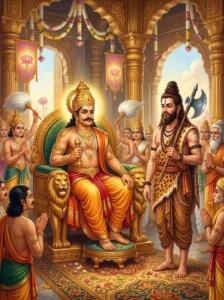
Future Manvantaras in the Vāyu Purāṇa follows Chapter 6 of the Uttarārdha (second half) of the Vāyu Purāṇa, which describes the seven manvantaras still to come in the present Vārāha Kalpa, from the eighth, the Sāvarṇika, to the fourteenth, the Bhautya or Indra-Sāvarṇa. Six manvantaras are past, and the seventh, the Vaivasvata, is the present one.
In the eighth, Sāvarṇi, born of Vivasvān and Chāyā, is Manu; the devas are the Sutapas, Amitābhas and Sukhas; and Bali, son of Virocana and grandson of Prahlāda, will be Indra, as Bhagavān Vishṇu in his Vāmana form promised him when he sent him to Sutala. Its saptarshis are Gālava, Jāmadagnya (Paraśurāma), Dvaipāyana Vyāsa, Kṛpācārya, Dṛshṭimanta of the Atri line, Ṛshyaśṛṅga and Aśvatthāmā; Paraśurāma and Aśvatthāmā are cirañjīvīs, who live on through the ages. The ninth to the fourteenth are told briefly, with their Manus and some of their devas, and with Śānti as Indra of the tenth. The Vāyu Purāṇa explains that the five Sāvarṇi Manus are so named because they are all born of Suvratā, a daughter of Daksha.
The Manvantaras in the Bhāgavata Purāṇa
The Bhāgavata Purāṇa counts the manvantaras among its own subjects. Śuka Maharshi names manvantara as the sixth of the ten subjects of the Bhāgavata, sarga, visarga, sthāna, poshaṇa, ūti, manvantara, īśānukathā, nirodha, mukti and āśraya, all taught so that the tenth, āśraya, may be known; here manvantara is the dharma practised by the mahātmās who rule the manvantaras (Skandha 2, Chapter 10). Sūta tells Śaunaka that the manvantaras are the fifth of the ten marks of a Mahāpurāṇa, and that a manvantara is the period in which six things go on: the Manu, the devatās, the sons of the Manu, Devendra, the maharshis and the aṃśāvatāras of Śrī Hari (Skandha 12, Chapter 7). The eighth skandha, the Purāṇa says at its close, describes the manvantaras, the release of Gajendra, and the avatāras of Bhagavān Vishṇu in the manvantaras, such as Hayagrīva and Ajita (Skandha 12, Chapter 12).
Maitreya teaches Vidura the measure of the manvantara (Skandha 3, Chapter 11): one day of Brahmā equals a thousand caturyugas, and fourteen Manus pass in it, each holding authority for about seventy-one caturyugas, while Bhagavān Śrī Hari, resting on sattva guṇa, protects the world through his mūrtis such as Manu. Śuka closes his list with the same reckoning (Skandha 8, Chapter 13; Skandha 12, Chapter 4); the measures of time are on Kālamāna.
Of the beings that Brahmā brought forth, the Manus came last: he created them by his mind to make beings prosper and rule the lokas, and the devas praised that creation, for on it rest yajña and the other karmas (Skandha 3, Chapter 20; see Brahmā’s Creation (Bhāgavata Purāṇa)). The ṛshis, the Manus, the devas, the sons of Manu and the prajāpatis are all aṃśas of Śrī Hari (Skandha 1, Chapter 3), and Śrī Hari takes avatāra in each of the manvantaras and upholds the worlds (Skandha 11, Chapter 4).
Śuka’s account in Skandha 8 begins with Parīkshit‘s request (Chapter 1). Having heard the line of Svāyambhuva Manu and the creation of the Prajāpatis, he asks to hear of the other Manus, and of the avatāras and līlās of Śrī Hari, the Purushottama, in the past manvantaras, in the present one and in those to come, and he promises to listen with śraddhā. When the list is complete, Parīkshit asks who appoints the Manu, his sons and the others to their works, and how (Chapter 14). Śuka answers:
- The Manu, the sons of Manu, the saptarshis, the devagaṇas and the Indras are all under the command and control of the Purushottama alone. Moved by his avatāras, Yajña and the others, they carry on the order of the world.
- When a mahāyuga ends, the maharshis by the power of their tapas see again, exactly as they were, the collections of the Vedas swallowed by time. It is these Vedas that uphold the sanātana dharma.
- Then the Manus, at Śrī Hari’s command, each in his own manvantara, with attentive minds make dharma with its four feet move on the earth, so that the people keep it.
- The sons of Manu divide the land as is fitting and rule the people by dharma for the whole manvantara. The devatās, with the ṛshis and pitṛs of the yajña rites, receive the shares of the yajña in each manvantara.
- Indra, enjoying the great wealth of the three worlds granted by Bhagavān Śrī Hari, protects the three worlds and rains well over the world as it needs.
- In every yuga Śrī Hari teaches jñāna in the form of siddhas such as Kapila, karma in the form of maharshis such as Yājñavalkya, and yoga in the form of yogeśvaras such as Dattātreya.
- Taking up the guṇas of sattva, rajas and tamas separately, he carries on creation in the form of prajāpatis such as Marīci, destroys thieves in the form of cakravartīs, and in the form of Time leads all beings towards dissolution.
- People deluded by the māyā of name and form praise Bhagavān Śrī Hari alone through many śāstras, yet they do not see his tattva.
- Vyāsa and the other knowers of the Purāṇas say that there are fourteen manvantaras, the inner divisions of a kalpa, in one kalpa.
The fourteen, as Śuka gives them:
| Manvantara | Manu | Indra | Avatāra of Śrī Hari |
|---|---|---|---|
| 1 | Svāyambhuva | Yajña | Yajña, son of Ruci and Ākūti |
| 2 | Svārocisha | Rocana | Vibhu, son of Vedaśiras and Tushitā |
| 3 | Uttama | Satyajit | Satyasena, son of Dharma and Sūnṛtā |
| 4 | Tāmasa | Triśikha | Hari, son of Harimedhas and Hariṇī |
| 5 | Raivata | Vibhu | Vaikuṇṭha, son of Śubhra and Vikuṇṭhā |
| 6 | Cākshusha | Mantradruma | Ajita, son of Vairāja and Sambhūti |
| 7 | Śrāddhadeva (Vaivasvata) | Purandara | Vāmana, son of Kaśyapa and Aditi |
| 8 | Sāvarṇi | Bali | Sārvabhauma, son of Devaguhya and Sarasvatī |
| 9 | Dakshasāvarṇi | Adbhuta | Ṛshabha, son of Āyushmat and Ambudhārā |
| 10 | Brahmasāvarṇi | Śambhu | Vishvaksena, son of Viśvasṛj and Vishūci |
| 11 | Dharmasāvarṇi | Vaidhṛta | Dharmasetu, son of Āryaka and Vaidhṛtā |
| 12 | Rudrasāvarṇi | Ṛtadhāmā | Svadhāmā, son of Satyasahas and Sūnṛtā |
| 13 | Devasāvarṇi | Divaspati | Yogeśvara, son of Devahotra and Bṛhatī |
| 14 | Indrasāvarṇi | Śuci | Bṛhadbhānu, son of Satrāyaṇa and Vitānā |
The Manus appear elsewhere in the Bhāgavata as well. One who desires birth as a kshatriya should worship the lords of the manvantaras (Skandha 2, Chapter 3), and the Manus worshipped Śrī Hari with kratus (Skandha 2, Chapter 6). Hiraṇyakaśipu brought even the Manus under his control, and when Bhagavān Narasiṃha had slain him they came as “the Manus who carry out your command” (Skandha 7, Chapters 4, 8). The Manus praised Vāmana at his birth and helped Brahmā install him (Skandha 8, Chapters 18, 23); the earth says that the Manus and their sons left her empty-handed (Skandha 12, Chapter 3); and the Manus fulfil the desires of those who glorify and hear the Bhāgavata (Skandha 12, Chapter 12).
The Manvantaras in the Bhavishya Purāṇa
Sumantu tells King Śatānīka that twelve thousand caturyugas make one deva-yuga and seventy deva-yugas one manvantara. In a day of Brahmā fourteen Manus rule: six of the line of Svāyambhuva Manu and seven of the future, with the names Sāvarṇa, Raucya and Dautya. When that day ends, he begins creation again. In the Madhyama Parva, Sūta says that seventy-two yugas make one manvantara and fourteen manvantaras one kalpa, which is one day and night of Brahmā.
Source: Bhavishya Purāṇa, Brahma Parva, Chapter 2; Madhyama Parva, Bhāga 1, Chapters 2–3
Later in the Brahma Parva he gives the names. The Manus are Svāyambhuva, Svārocisha, Uttama, Tāmasa, Raivata, Cākshusha and Vaivasvata, the present one, and then Arkasāvarṇi, Bahusāvarṇi, Bhavasāvarṇi, Dharusāvarṇi, Dakasāvarṇi, Raucya and Bhautya. The Indras are Vishṇubhuk, Vidyuti, Vibhu, Prabhu Indra, Śikhi, Manojava, Ojasvī, the Indra of the present time, Bali, Bhāvya, Adbhuta, Susāttvika, also called Śānta, Kīrti, Śatadhāma, also called Ṛtudhāma, and Divaspati. The Saptarshis he names are Kaśyapa, Atri, Vasishṭha, Bharadvāja, Gautama, Viśvāmitra and Jamadagni. In all the manvantaras, karma done according to varṇa and āśrama comes to the highest fulfilment.
Source: Bhavishya Purāṇa, Brahma Parva, Chapters 44, 125
The Pratisarga Parva sets its accounts within the manvantaras, and each page below tells them. In the Svāyambhuva manvantara Satī was born among Daksha‘s sixty daughters. In the Svārocisha manvantara Bhagavān Śaṅkara promised Rati her husband Pradyumna. In the Tāmasa manvantara the varṇas fell from the Veda and Tripura was burned. In the Cākshusha manvantara a great tempest left the earth a thousand years in the water. In the Vaivasvata manvantara Brahmā performed his yajña at Utpalāraṇya, Bhagavān Rāma took avatāra and the war of Kurukshetra took place. The Raivata and Sāvarṇi pages give what the Purāṇa says of those Manus.
Source: Bhavishya Purāṇa, Pratisarga Parva, Khaṇḍa 1, Chapter 1; Khaṇḍa 3, Section 1; Khaṇḍa 4, Chapters 5, 9, 12–14
The Purāṇa often measures the phala of a holy act by the manvantara, from a stay of some manvantaras for the Saptamī rule, through fourteen for the fast of the tithi foods, to a hundred for the Hiraṇyagarbha-dāna and the Aśvaratha, and more than a hundred for the Dhānyaśaila. The great gifts are told on Mahā Dāna Vidhi.
Source: Bhavishya Purāṇa, Brahma Parva, Chapters 16, 47; Uttara Parva, Chapters 176, 180, 195
The Manvantaras in the Brahma Purāṇa
In the Brahma Purāṇa, Lomaharshaṇa, the Sūta, tells the munis that in the first creation the Virāṭ Purusha created Manu, and that the life-span of Svāyambhuva Manu, seventy-one mahāyugas, is called a manvantara (Chapters 1–2). In the Manvantara-kīrtana of Chapter 5 he names the Manus from Svāyambhuva to Vaivasvata, whose manvantara is running now, with the saptarshis, devas and sons of each, then the Manus to come, from Sāvarṇi to Merusāvarṇi; the telling of the names of the fourteen Manus brings blessedness, and at the end of the kalpa all beings, with Brahmā at their head, enter into Nārāyaṇa, who creates again.
The Purāṇa also measures time and merit by the manvantara: Indra‘s sovereignty, the śrāddha days, the lokas gained by those who worship Vāsudeva, the fourteen Manus of a kalpa (Chapters 191, 220, 227–228, 232, 239). All of this is told in full on The Manvantaras in the Brahma Purāṇa.
Source: Brahma Purāṇa, Chapters 1–2, 5, 191, 220, 227–228, 232, 239
The Manvantaras in the Brahma Vaivarta Purāṇa
The measure of a manvantara. Sauti tells Śaunaka at Naimisha that seventy-one divine yugas make one manvantara and fourteen manvantaras one day of Brahmā. In the Prakṛti Khaṇḍa Nārāyaṇa Maharshi tells Nārada the measures of time: a human year is a day of the devas; when three hundred and sixty human yugas pass it is one yuga of the devas; when seventy-one deva yugas pass it is a manvantara; an Indra lives one manvantara; the lives of twenty-eight Indras make one day of Brahmā, and Brahmā’s life is complete in a hundred and eight years. Elsewhere the Purāṇa gives a manvantara as twenty-one divine yugas.
Sutapā, a Vaishṇava and a disciple of Śiva, teaches King Suyajña that as a wheel turns, so the yugas and the manvantaras turn one after another. A manvantara is seventy-one divine yugas, twenty-five thousand five hundred and six yugas by human measure, and an Indra lives as long as a Manu. When fourteen Indras have passed it is a day of Brahmā, and when another fourteen pass it is his night, the Brahmarātri, which the Vedas call the Kālarātri. At the dainandina pralaya, Sūrya and Candra, the dikpālakas, the Ādityas, the Vasus, the eleven Rudras, the fourteen Manus, the ṛshis, the munis, the gandharvas, the rākshasas and all the rest perish.
Durvāsa Maharshi, teaching Indra, names Indratva and Manutva among the gifts of the Mahādeva mantra, and gives the life of a Devendra and of a Manu as twenty-five thousand five hundred and sixty human yugas. Rādhā teaches that seventy-one yugas of the devatās are the time of one Manu, and that a Manu’s life is limited. Consoling Nanda, Śrī Kṛshṇa says that at the end of twenty-five thousand yugas a Manu dies, that the full life of Mahendra is equal to a Manu’s, that when fourteen Indras have perished it is one day of Brahmā and the night is as long, and that the whole life of Brahmā is for him the blink of an eye. In the stotra of Durvāsa Maharshi to Bhagavān Nārāyaṇa, when twenty-eight Manus and Mahendras pass it is one night and day of Brahmā, and Brahmā’s life of a hundred and eight years ends in the time it takes Śrī Hari to close and open his eye.
Source: Brahma Vaivarta Purāṇa, Brahma Khaṇḍa, Chapters 5, 17; Prakṛti Khaṇḍa, Chapters 7, 36, 54; Śrī Kṛshṇa Janma Khaṇḍa, Chapters 25, 74, 96
The fourteen Manus. Nārāyaṇa Maharshi tells Nārada that the brāhmaṇa Sutapā told King Suyajña the account of the dharmic Manus as Śaṅkara had told it to him:
- Svāyambhuva, the son of Brahmadeva, whose wife is Śatarūpā: supremely dharmic, the best of the Manus, a great devotee of Vishṇu, whose guru was Śaṅkara himself; he is Suyajña’s great-grandfather. On the bank of the Narmadā he completed a thousand rājasūyas and lakhs of aśvamedhas and other yāgas, fed three crore brāhmaṇas every day and gave endless dānas for the pleasure of Vishṇu at Śaṅkara’s command. From Śaṅkara he received true jñāna, the Śrī Kṛshṇa mantra and Śrī Kṛshṇa-dāsya, and at last reached Goloka; he is called Svāyambhuva as the son of Svayambhū.
- Svārocisha, the son of Agnideva, created by Brahmā after Svāyambhuva, dharmic and a giver of endless dānas.
- and 4. The two sons of Mahārāja Priyavrata, dharmic, devoted to Kṛshṇa-bhakti, whose guru was Maheśvara (the text does not name them).
- Raivata.
- Cākshusha, devoted to Vishṇu-bhakti.
- Śrāddhadeva, the son of Sūrya.
- Sāvarṇi, also a son of Sūrya.
- Dakshasāvarṇi.
- Brahmasāvarṇi.
- Dharmasāvarṇi.
- Rudrasāvarṇi.
- Devasāvarṇi.
- Candrasāvarṇi, rich in endless jñāna.
All these Manus were supremely dharmic, great jñānīs, and worshipped Śrī Kṛshṇa. In the Prakṛti Khaṇḍa Nārāyaṇa also tells of a line of Sāvarṇi Manus: Dakshasāvarṇi, a bhakta of Vishṇu; his son Dharmasāvarṇi; his son Vishṇusāvarṇi; his son Devasāvarṇi, all Vishṇu-bhaktas devoted to Vishṇu-vratas; and Devasāvarṇi’s son, the Śiva-bhakta King Vṛshadhvaja.
Source: Brahma Vaivarta Purāṇa, Prakṛti Khaṇḍa, Chapters 13, 54
The Manus and Śrī Kṛshṇa. Nārāyaṇa Maharshi tells Nārada: “You, we, the Manus, the maharshis, all are aṃśāṃśas of Śrī Kṛshṇa”; the Manus, munīndras and all beings come from an aṃśa-kalā of the sixteenth part of one of Śrī Hari’s kalās. In each of the endless universes Brahmā, Vishṇu, Śiva, the munis, the Manus and all beings are separate. The Manus always bow to Śrī Kṛshṇa, serve the Parameśvara beyond Prakṛti, worship Durgā, and serve the lotus feet of Śrī Kṛshṇa with Brahmā, Rudra, Śesha, Lakshmī, Sarasvatī and the devīs; Devī Pārvatī names them among those who meditate on him. Yet the fourteen Manus do not see him even in a dream, and Brahmā, Ananta, Dharma, the Manus and the Vedas do not know a sixteenth of the glory of his name, and the gopī Śaśikalā tells Mādhavī that Padmā, Sarasvatī, Durgā, Ananta, Maheśvara, the siddhas, Indra, the munis and Manu do not fully know him; Bhagavān Śiva tells that he himself, Brahmā, Indra, the devas, the munīndras and the Manus come forth and dissolve at the mere movement of Śrī Hari’s eyebrows. Manus, humans, munis and Vaishṇavas who chant the Kṛshṇa mantra become pure and go to his loka. By karma, the Purāṇa teaches, a jīva is born a deva, a Manu, a great king or a muni, or in a lower birth; and by the Rādhā kavaca Manu became ruler of humans. The kshatriyas were born from the gotras of Candra, Sūrya and the Manus.
Source: Brahma Vaivarta Purāṇa, Brahma Khaṇḍa, Chapters 1, 10, 18, 30; Prakṛti Khaṇḍa, Chapters 1, 10, 24, 56; Śrī Kṛshṇa Janma Khaṇḍa, Chapters 4, 7, 13, 19, 25, 65, 94, 115
The passing of the Manus. Śrī Kṛshṇa tells Nanda on his return from Goloka that the sixteen mahārājas of the earth and the fourteen Manus all came under kāla when the fruit of their karma ripened, and that in the one kshaṇa that had passed for Nanda in Goloka, seven manvantaras had passed on earth, seven Indras had passed away and the eighth was in office. Śrī Hari tells Brahmā and the devas that half a kshaṇa in Goloka is one manvantara on earth, so that Śaṅkhacūḍa, who ruled as cakravartī over devas, dānavas, gandharvas, kinnaras and rākshasas for one manvantara, would spend one manvantara on earth and then return to Goloka; Tulasī was his wife for that one manvantara. Of the fourteen Indras, five are the five Pāṇḍavas. When Manu falls, the Moon falls and disappears. And Śrī Kṛshṇa was with Virajā for a lakh manvantaras, a short time in Goloka, where there is no birth or death.
Source: Brahma Vaivarta Purāṇa, Prakṛti Khaṇḍa, Chapters 16, 21, 49; Śrī Kṛshṇa Janma Khaṇḍa, Chapters 6, 116, 125
The Manus at the great events. The Manus came with many instruments to Kailāsa for Devī Pārvatī’s vrata; they rejoiced at the birth of Śrī Kṛshṇa and praised him after the end of Vṛka; they went with Brahmā, Vishṇu and Śiva, their lips dry, to see the Sarveśvara when the Gaṅgā had withdrawn from sight; they wept with bowed heads with the devas and munis; they laughed at Indra; they came to the great pūjā of Gaṇeśa at Siddhāśrama and bowed to Rādhā and praised her; and they went with Īśāna and the devas to Bhāṇḍīra when Śrī Kṛshṇa prepared to go to Goloka. Maṅgalacaṇḍikā became Īśvarī of all the devas when the devas, munis, Manus and humans worshipped her; Manasā was worshipped by Śrī Kṛshṇa, Śiva, Kaśyapa, the devatās, Manu, the munis, the serpents and humans; and Manu, kings, ṛshis and gandharvas worship Śrī Devī in Bhārata. The jackal Śṛgāla claimed that all the Manus and munis exist by his aṃśa.
Source: Brahma Vaivarta Purāṇa, Prakṛti Khaṇḍa, Chapters 11, 35, 44, 46; Gaṇeśa Khaṇḍa, Chapter 6; Śrī Kṛshṇa Janma Khaṇḍa, Chapters 7, 36, 56, 61, 121, 123–124, 129
Tapas, phala and naraka measured in manvantaras. Bhagavān Śiva, Brahmā, Vishṇu and Dharma performed tapas for a hundred manvantaras, Ādiśesha for one, and Sūrya, Candra and Indra for one; Śiva tells that Nārāyaṇa gave him jñāna as the fruit of tapas of a hundred manvantaras, and Dharma that Vishṇu gave him sanātana dharma as the fruit of tapas of seven. The śakti of Śrī Kṛshṇa bore the garbha for a hundred manvantaras before bringing forth the golden egg. Vedavatī performed fierce tapas at the Pushkara tīrtha for a manvantara and did not waste away. A pativratā who draws out her departed husband lives with him in svarga for a manvantara.
The phalas of holy acts are measured in manvantaras, from one to a crore: one who gives gavya, silver, cloth, grain, fruit, water or a daughter to brāhmaṇas lives in Candraloka for a manvantara, and a bath at the time of a manvantara and at the start of the year gives a hundredfold fruit. So are the narakas: placing sandalwood, rudrāksha or darbha on the bare ground brings naraka for a manvantara; seizing another’s land leads to Taptaśūla for seven manvantaras; killing for money with swords keeps one in Asipatra until fourteen Indras pass; in other narakas women eat filth for a manvantara; and one who transgresses the Daśamī of the Ekādaśī vrata dwells in Andhakūpa for a hundred manvantaras.
Source: Brahma Vaivarta Purāṇa, Brahma Khaṇḍa, Chapter 13; Prakṛti Khaṇḍa, Chapters 2, 7, 9–10, 14, 26–27, 30–31; Gaṇeśa Khaṇḍa, Chapter 28; Śrī Kṛshṇa Janma Khaṇḍa, Chapter 26
Sources
- Mārkaṇḍeya Purāṇa, Chapters 50, 58–98
- Vāmana Purāṇa, Chapters 46, 65; Saro Māhātmya, Chapters 10, 15, 24
- Agni Purāṇa, Chapters 1, 18, 19, 107, 150, 219, 273, 383
- Bhāgavata Purāṇa, Skandha 1, Chapter 3; Skandha 2, Chapters 3, 6, 10; Skandha 3, Chapters 11, 20–24; Skandha 4, Chapter 1; Skandha 5, Chapters 1, 24; Skandha 6, Chapter 4; Skandha 7, Chapters 4, 8; Skandha 8, Chapters 1–14, 18, 22–24; Skandha 10, Chapter 3; Skandha 11, Chapter 4; Skandha 12, Chapters 3–4, 7, 12
- Brahmāṇḍa Purāṇa, Pūrva Bhāga, Chapters 8–9, 35, 36
- Vāyu Purāṇa, Uttarārdha, Chapters 1, 6
- Kūrma Purāṇa, Pūrvārdha, Chapter 51
- Vishṇu Dharmottara Purāṇa, Pūrvārdha, Chapters 176, 178, 183, 186
- Bhavishya Purāṇa, Brahma Parva, Chapters 2, 16, 44, 47, 125; Madhyama Parva, Bhāga 1, Chapters 2–3; Pratisarga Parva, Khaṇḍa 1, Chapter 1; Khaṇḍa 3, Section 1; Khaṇḍa 4, Chapters 5, 9, 12–14; Uttara Parva, Chapters 2, 175–180, 182, 190, 195
- Brahma Purāṇa, Chapters 1–2, 5, 191, 220, 227–228, 232, 239
- Brahma Vaivarta Purāṇa, Brahma Khaṇḍa, Chapters 1, 5, 10, 13, 17–18, 30; Prakṛti Khaṇḍa, Chapters 1–2, 7, 9–11, 13–14, 16, 21, 24, 26–27, 30–31, 35–36, 44, 46, 49, 54, 56; Gaṇeśa Khaṇḍa, Chapters 6, 28; Śrī Kṛshṇa Janma Khaṇḍa, Chapters 4, 6–7, 13, 19, 25–26, 36, 56, 61, 65, 74, 94, 96, 115–116, 121, 123–125, 129
 Cākshusha Manvantara
 Dharmasāvarṇi Manvantara
 Future Manvantaras in the Vāyu Purāṇa
 Kapotaka, A Nāga King of Uttama Manvantara
 Nandā, A Nāginī
 Raivata Manvantara
 Ruci, Father of Raucya Manu
 Sāvarṇi Manvantara
 Svārocisha Manvantara
 Svāyambhuva Manvantara
 Tāmasa Manvantara
 Vaivasvata Manvantara
 Vibhāvarī, Wife of Svaroci