Divine Birds of Sanātana Dharma
Divine birds occupy a uniquely exalted position in the sacred literature of Sanātana Dharma. From the earliest hymns of the Rigveda to the elaborate narratives of the Puranas and the great epics — the Mahabharata and the Ramayana — birds appear as vehicles (vahanas) of the gods, as divine messengers, as embodiments of the soul, and as repositories of sacred wisdom. They bridge the terrestrial and celestial realms, symbolising both the aspiration for spiritual liberation (moksha) and the cosmic forces that sustain the universe.
Sanātana Dharma does not treat divine birds merely as symbolic motifs. Many are worshipped as deities in their own right, possess independent narratives across multiple scriptures, and carry doctrinal significance within the Vedanta, Shaiva, Vaishnava, and Shakta traditions. The Mundaka Upanishad famously describes two birds perched on the same tree — one eating fruit, the other watching silently — an allegory for the individual soul (jiva) and the supreme soul (paramatman). This image has become one of the most enduring metaphors in Indian philosophical thought.
This article serves as a parent reference for the individual biographies of divine birds offering historical context, textual sources, and thematic classification for each sacred avian figure in the Sanātana Dharma.
Origins in Vedic Literature
The Rigveda contains numerous references to a celestial bird called Garuda or Garutman or Suparna (“the golden-winged one”), described The Rigveda also describes a divine hawk or eagle, Shyena, who ascends to heaven to retrieve the sacred Soma plant and bring it to earth for the benefit of gods and humanity.
The Yajurveda elaborates on the Suparna as the form of the fire altar used in the Agnisayana ritual, a twelve-day Vedic ceremony. The altar, constructed in the shape of a bird with outstretched wings, symbolically carried the patron of the ritual (yajamana) to the heavens. Its five sections, head, body, two wings, and tail, were identified with the five elements and the five vital breaths (pranas).
The Shatapatha Brahmana, embedded within the Yajurveda, further identifies Garuda with the personification of courage.
Major Divine Birds of the Sanātana Dharma
Garuda: King of Birds and Mount of Bhagavān Viṣṇu
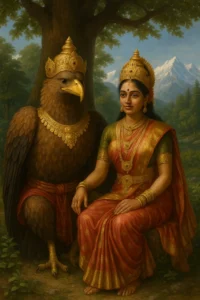
Garuda (Sanskrit: गरुड) is the most celebrated divine bird in Hinduism. He is the king of all birds, the divine mount (vahana) of Lord Vishnu, and a deity revered across Hindu, Buddhist, and Jain traditions. Born to the sage Kashyapa and Vinata, Garuda is the younger brother of Aruna, the charioteer of the sun god Surya.
The Mahabharata describes Garuda as a being of immense power whose wing-flapping could halt the rotation of the three worlds — heaven, earth, and the netherworld. He is typically depicted in either a fully zoomorphic form (a giant eagle with partially spread wings) or an anthropomorphic form (a man with wings, a beak-like nose, and bird-like features). His body is said to display four bands of colour: golden-yellow from feet to knees, white from knees to navel, scarlet from navel to neck, and black above the neck.
Garuda’s mythology centres on his rivalry with the Nagas (serpent beings), who are the children of his aunt Kadru. To free his mother Vinata from servitude to Kadru, Garuda stole the amrita (nectar of immortality) from the gods. This feat established his reputation for extraordinary courage and earned him the appointment as Vishnu’s eternal vehicle. A dedicated text, the Garuda Purana, bears his name and deals with subjects ranging from cosmology to funerary rites.
Aruṇa: Charioteer of the Sun
Aruṇa is the elder brother of Garuda and the charioteer (sarathi) of the sun god Surya. Born from the same egg as Garuda but emerging prematurely, Aruṇa is typically described as having an incomplete or reddish-hued form, personifying the crimson glow of dawn. His name itself means “reddish-brown” in Sanskrit, evoking the colour of the sky just before sunrise.
Aruṇa is the father of two of the most important bird-heroes of the Ramayana: Jatāyu and Sampāti. Through his lineage, Aruṇa connects the celestial realm of solar mythology with the terrestrial heroism of the epic narratives.
Jatāyu: The Noble Vulture of the Ramayana
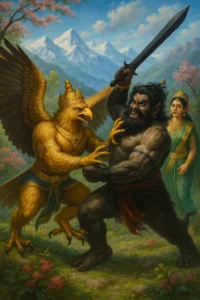
Jatāyu is one of the most beloved divine birds in Sanātana Dharma . The younger son of Aruna (and therefore a nephew of Garuda), Jatāyu was an aged vulture king who was a friend of King Dasharatha, the father of Rama. In the Ramayana, when the demon king Ravana abducted Sita, Jatāyu was the only being who attempted to intervene. Despite his advanced age, the noble vulture fought ferociously against Ravana, tearing at his chariot and wounding him repeatedly.
Ravana ultimately severed Jatāyu’s wings with his sword, and the mortally wounded bird fell to the earth. When Rama and Lakshmana discovered the dying Jatāyu during their search for Sita, the bird was able to convey the direction in which Ravana had fled before breathing his last. Rama was deeply moved and performed Jatāyu’s funeral rites himself — a honour typically reserved for one’s own father. Jatāyu’s sacrifice represents the Hindu ideals of loyalty (bhakti), selfless service (seva), and righteous courage (dharma-vira).
Sampāti: The Far-Seeing Vulture King
Sampāti is the elder brother of Jatāyu and the king of vultures. In his youth, Sampāti and Jatāyu once flew towards the sun. Sampāti shielded his brother with his own wings, which were scorched by the sun’s heat. He fell to the earth, wingless and aged, living in exile on a mountain by the sea.
In the Ramayana, when Hanuman and the vanara (monkey) army reached the southern coast in search of Sita, they encountered the aged Sampāti. Upon hearing of his brother Jatāyu’s noble death at Ravana’s hands, Sampāti was filled with grief and determination. Despite his disability, he possessed extraordinary far-sight inherited from his Garuda lineage, and was able to see across the ocean to Lanka, confirming Sita’s location. This intelligence proved decisive in Rama’s campaign to rescue Sita.
Shyena: The Divine Hawk of Agni
Shyena (Sanskrit: श्येन, meaning “hawk” or “falcon”) is one of the most ancient divine birds, identified with Agni, the fire god. In the Rigveda, the Shyena ascends to heaven and retrieves the Soma — the sacred elixir — bringing it to earth for the rejuvenation and revitalisation of all living things. This act establishes the Shyena as a mediator between the divine and earthly realms, a proto-figure for Garuda’s later role as the bringer of amrita.
Birds as Vahanas (Divine Vehicles)
Several Hindu deities are specifically associated with avian mounts. These vahanas are not mere transportation; they are living embodiments of the deity’s qualities and powers. The following table summarises the principal bird-vahana associations:
| Deity | Bird Vāhana | Species | Symbolism |
| Vishnu | Garuda | Eagle / Kite | Power, protection, speed |
| Brahma | Hamsa | Swan / Goose | Wisdom, discernment, purity |
| Saraswati | Hamsa / Shuka | Swan / Parrot | Knowledge, eloquence |
| Kartikeya | Paravani | Peacock | Valour, beauty, transcendence |
| Lakshmi | Uluka | Owl | Patience, vigilance in darkness |
| Kamadeva | Shuka | Parrot | Love, desire, eloquence |
| Shani | Gridhra | Vulture / Crow | Karma, endurance, patience |
The Hamsa (swan or goose) deserves special mention. As the vehicle of Brahma the Creator and Saraswati the Goddess of Learning, it symbolises the highest viveka (discernment) — the ability to separate milk from water, truth from illusion. Spiritually enlightened persons are honoured with the title Paramahamsa (“supreme swan”), indicating their mastery over the distinction between the real and the unreal.
Divine Birds in the Puranas
The Four Cataka Birds of the Markandeya Purana
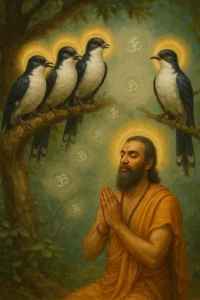
The Mārkandeya Purāṇa , one of the oldest and most important of the eighteen Maha Purāṇas, opens with a remarkable narrative framework involving four wise birds. The sage Jaimini, a disciple of Vyāsa, approached the great rishi Mārkandeya seeking answers to four questions raised by the Mahabharata. Mārkandeya, about to undertake his evening Vedic rituals, directed Jaimini to seek out four extraordinary birds dwelling in the Vindhya mountains.
These four birds were the sons of a bird named Drona (not the Mahabharata warrior of the same name) and his wife Tarkshi, who was in reality the celestial nymph (apsara) Vapu, cursed by the Ṛṣi Durvāsa to be reborn in avian form. While pregnant, Tarkshi flew over the battlefield of Kurukshetra during the great Mahabharata war. Struck by an arrow from Arjuna’s bow, she laid four eggs as she fell. A great bell, dislodged from the war-elephant Supratika, fell over the eggs, shielding them from the carnage. The four eggs hatched within this protective bell, and the chicks witnessed the entirety of the epic war from their sheltered vantage point.
After the war, the sage Shamika discovered the young birds, nurtured them, and raised them in his ashram. Having absorbed the teachings of the sage and the dharmic lessons of the war itself, the birds grew into beings of profound wisdom. They perched upon a great tree and dispensed sacred knowledge to all who sought them out. Their conversation with Jaimini constitutes chapters 1 through 44 of the Markandeya Purana and encompasses moral instruction, the theory of karma and samsara, dharma, shraddha rites, and the philosophy of yoga.
For a detailed biography, see: The Four Cataka Birds in the Markandeya Purana
Kandharu
Kandharu (also rendered as Kandhara) is a king of the birds who features prominently in the early chapters of the Mārkanḍeya Purāṇa. He is the father of Tarkshi and the grandfather, through her, of the four wise Cataka birds. When his elder brother Kanka was slain by the Rakshasa Vidyudrupa, Kandharu was consumed with righteous fury. He undertook a solo campaign against the demon, storming the mountain stronghold where Vidyudrupa resided with his wife Madanika.
In a fierce battle, Kandharu vanquished the Rakshasa. Madanika, the daughter of the celestial nymph Menaka, sought refuge with Kandharu, assuming the form of a she-bird. Kandharu married her, and from their union was born Tarkshi — the cursed apsara Vapu reborn in avian form. Through Kandharu’s lineage, the sacred wisdom that ultimately reached sage Jaimini came into being.
For a detailed biography, see: Kandharu — Biography of the Avian King
Kanka
Kanka is the elder brother of Kandharu and a noble figure in the avian lineage of the Mārkanḍeya Purāṇa. While travelling near a mountain, Kanka inadvertently witnessed the Rakshasa Vidyudrupa in a private moment with his wife. The enraged demon confronted the bird, and when Kanka stood his ground — asserting that a mountain is a public place and affords no expectation of privacy — the Rakshasa killed him.
Kanka’s death served as the catalyst for the chain of events that led to Kandharu’s avenging battle, the birth of Tarkshi, and ultimately the existence of the four wise birds. In the Puranic narrative, Kanka embodies the principle that righteous speech, even when met with fatal consequence, sets the wheels of dharma into motion.
For a detailed biography, see: Kanka — The Martyr Bird
Other Legendary Birds
Gandaberunda: The Two-Headed Bird of Immeasurable Strength
The Gandaberunda (also Gandabherunda) is a two-headed mythological bird associated with both Viṣṇu and Śiva. According to Śiva Purāṇa and Linga Purāṇa, when Vishnu’s fierce Narasimha avatar could not be subdued after slaying the demon Hiranyakashipu, Shiva assumed the form of Sharabha — a part-lion, part-bird creature. In response, from the body of Narasimha emerged the Gandaberunda, a two-headed bird of unimaginable power. The two beings battled for eighteen days before peace was restored and both deities resumed their original forms.
The Gandaberunda was adopted as a royal emblem by the Vijayanagara Empire around 1510 CE and continues to serve as the official state emblem of Karnataka, India.
Chataka: The Bird That Drinks Only Rainwater
The now extinct Chataka (sometimes identified as a variant of Pied Crested Cuckoo, Clamator jacobinus) holds a special place in Hindu devotional literature as a symbol of spiritual aspiration. Purāṇas describe this bird as one who never drinks water from earthly sources — rivers, lakes, or ponds — but waits with unwavering patience for fresh raindrops to fall directly from the clouds. This behavior is taken as a metaphor for the true devotee who refuses to accept anything less than the grace of God, rejecting worldly substitutes for divine nourishment.
Chakora: The Moonbeam Partridge
The now extinct Chakora bird is a legendary partridge to subsist entirely on moonbeams, gazing perpetually at the moon with unwavering devotion. In Sanskrit poetry and Hindu devotional literature, the Chakora represents the devoted soul that finds sustenance only in the beauty of the divine. It appears frequently in kavya (classical Sanskrit poetry) as a metaphor for the lover transfixed by the beloved’s radiance.
Homa Pakshi: The Vedic Bird of Paradise
The now extinct Homa Pakshi (also Huma bird) is a bird in Vedic times to spend its entire life in flight, never touching the earth. According to tradition, it lays its eggs while airborne, and the hatchling learns to fly before the egg reaches the ground. The Homa bird represents detachment from the material world, perpetual spiritual ascent, and the soul’s transcendence of earthly limitation.
Krauncha: The Crane of the Ramayana
The Krauncha crane holds a special place in Indian literary history. In the opening verses of Valmiki’s Ramayana, the sage Valmiki witnessed a hunter’s arrow strike down one of a pair of Krauncha birds in the midst of their love-play. The grief of the surviving bird moved Valmiki to utter a spontaneous verse of lament, which became the first shloka (metrical verse) of Sanskrit poetry. This moment is traditionally celebrated as the birth of kavya — and a bird’s sorrow was its catalyst.
Shuka: The Parrot Sage
Shuka (meaning “parrot” in Sanskrit) was the son of the sage Vyāsa. According to the Purāṇas, a baby parrot overheard Śiva narrating divine secrets to Pārvatī. Pursued by Śiva, the parrot fled to earth and entered the womb of Vyasa’s wife, taking the form of a human embryo. The child, born after twelve years, was named Shuka. He possessed the extraordinary ability to remember and recite everything he heard — a quality associated with parrots, and became the narrator of the Bhāgavata Maha Purāṇa, reciting it to King Parikshit in the seven days before Parikshit’s death.
Shuka is venerated as a Paramahamsa and is considered to have been at a higher spiritual level than even his illustrious father Vyasa.
Birds and the Origin of the World
In the Brahmānda Purana and other cosmological texts, the cosmic egg (Brahmanda) from which the universe emerges is sometimes associated with a divine bird. Brahma himself is linked to the Hamsa, and the act of creation is imagined as a golden egg from which all reality hatches.
Gods Who Assumed Bird Forms
Hindu mythology records several instances in which the gods themselves took the form of birds. According to a narrative in the Mahabharata and various Puranas, when the demon king Ravana arrived at a sacrifice being performed by King Marutta, the assembled gods panicked and disguised themselves as animals and birds. Indra became a peacock, Yama became a crow, Varuna assumed the form of a swan, and Kubera turned into a chameleon.
In gratitude, each god bestowed a blessing on the creature whose form they had assumed. Indra granted the peacock its iridescent plumage. Yama gave crows the right to receive Pitru Bali — the ritual offering of food to ancestors. Varuna blessed the swan with its pure white colour. These aetiological myths explain not only the physical characteristics of birds but their ritual significance in Sanātana Dharma.
Classification of Divine Birds by Textual Source
The following table organises the major divine birds of Hinduism by their primary textual sources:
| Bird | Primary Source(s) | Role / Significance |
| Garuda | Rigveda, Mahabharata, Garuda Purāṇa | King of birds; mount of Vishnu; bringer of amrita |
| Jatāyu | Ramayana | Noble vulture; died defending Sita |
| Sampāti | Ramayana | Vulture king; guided Rama’s army to Lanka |
| Shyena | Rigveda | Divine hawk; retrieved Soma from heaven |
| Hamsa | Upanishads, Purāṇas | Mount of Brahma and Saraswati; symbol of discernment |
| Four Cataka Birds | Mārkandeya Purāṇa | Wise birds who expound dharma and philosophy |
| Kandharu | Mārkandeya Purāṇa | Avian king; father of Tarkshi; avenger of Kanka |
| Kanka | Mārkandeya Purāṇa | Martyr bird; his death sparked the Cataka lineage |
| Gandaberunda | Śiva Purāṇa, Linga Purāṇa | Two-headed bird; emerged from Narasimha |
| Chataka | Śiva Purāṇa, Linga Purāṇa | Symbol of spiritual aspiration; drinks only rainwater |
| Chakora | Sanskrit kavyas | Moonbeam partridge; symbol of unwavering devotion |
| Shuka | Bhāgavata Purāṇa | Parrot-sage; narrator of the Bhagavata |
| Krauncha | Ramayana | Crane; its killing inspired the first Sanskrit verse |
| Homa Pakshi | Vedic tradition | Mythical sky-bird; never touches the ground |
Cultural and Ritual Significance
Divine birds permeate Hindu ritual life. Garuda statues guard the entrances of Vishnu temples across India and Southeast Asia. Crows are fed during Shraddha ceremonies as emissaries of departed ancestors, reflecting Yama’s blessing upon them. Peacock feathers are integral to the iconography of Krishna, who wears one in his crown, and the peacock dance (Mayura nritya) is a celebrated motif in classical Indian dance forms such as Bharatanatyam.
The Brahminy Kite (Haliastur indus), with its distinctive rust-and-white plumage, is worshipped in parts of South India as a living manifestation of Garuda. Owls, the vehicle of Lakshmi, are considered auspicious during Diwali. The parrot, as the companion of Kamadeva (god of love) and Saraswati, holds significance in both romantic and scholarly contexts in Hindu culture.
The Taittiriya Upanishad itself takes its name from tittiri, a type of partridge, connecting avian nomenclature to the very foundations of Vedantic philosophy.
Divine Birds in Temple Art and Iconography
Hindu temples across the Indian subcontinent and Southeast Asia abound with avian imagery. Garuda is ubiquitous in Vaishnavite temples, frequently appearing on a dedicated pillar (Garuda Stambha) opposite the main shrine. The Gandaberunda is carved into the pillars of many temples including the infamous Chennakesava temple at Belur. Peacocks adorn the gopurams (temple towers) of Murugan shrines throughout Tamil Nadu.
Scriptural Sources and References
The following primary texts inform the study of divine birds in Hinduism:
- Rigveda: Hymns to Garutman/Suparna and Shyena
- Yajurveda (Shatapatha Brahmana): Garuda as personification of courage; Agnisayana bird-altar
- Mundaka Upanishad (3.1.1) : Parable of the two birds
- Shvetashvatara Upanishad (4.6): Two birds on the Pippala tree
- Taittiriya Upanishad: Named after the tittiri partridge
- Mahabharata: Garuda narratives; Suparṇākhyāna; genealogies of birds
- Ramayana (Valmiki): Jatāyu, Sampāti, Krauncha crane episodes
- Markandeya Purāṇa (chapters 1–44): Four Cataka birds, Kandharu, Kanka, Tarkshi
- Garuda Purāṇa: Named after Garuda; covers cosmology and funerary rites
- Śiva Purāṇa: Chataka, Sharabha, Gandaberunda narratives
- Bhāgavata Purana: Shuka as narrator; parrot-sage mythology
- Devi Mahatmya (within Markandeya Purāṇa, chapters 81–93) – Contextual framework of the bird narrative