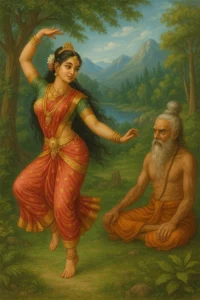
Apsaras
The word Apsaras (अप्सरस्) is derived from Sanskrit roots. The most widely accepted derivation breaks the word into “ap” (अप्) meaning water and “saras” (सरस्) meaning pond, lake, or one full of essence and desire. This gives the literal meaning of “one who moves in the waters” or “the essence of water.” According to Yāska’s Nirukta, the earliest etymological dictionary of Sanskrit, the word means “moving in the waters.” An alternate etymology offered in the Śatapatha Brāhmaṇa explains it as “apsu rasa” — the essence of the ocean water that was produced during the churning, when the Apsaras and the physician-god Dhanvantari first rose from the cosmic ocean.
In colloquial Hindi and other modern Indian languages, the word apsara is used to denote an exceedingly beautiful woman or a talented dancer.
Origins & Creation
The origin stories of the Apsaras vary across Hindu scriptures, reflecting their deep mythological complexity:
1. Samudra Manthana (Churning of the Milky Ocean): The most widely known account, found in the Rāmāyaṇa and multiple Purāṇas, describes the Apsaras emerging from the foam of the cosmic ocean during the great churning (Samudra Manthana). According to the Rāmāyaṇa, they appeared after the Kalpavṛkṣa (wish-fulfilling tree). Gorgeous and bejewelled, draped in attractive robes and golden ornaments, they emerged and were claimed by neither the Devas nor the Asuras — and thus they became available to all, earning a degree of independence unique among celestial beings.
2. Manu Smṛti / Manu Śāstra: According to the Manu tradition, the Apsaras were created alongside the seven Manus themselves, fashioned to serve as wives of the gods and as embodiments of aesthetic delight.
3. Brahma’s Mental Creation (Nāṭya Śāstra): The Nāṭyaśāstra of Bharata Muni describes them as mental creations of Brahmā. When Brahmā composed the fifth Veda — the Nāṭyaveda — by selecting hymns from the Ṛgveda, melody from the Sāmaveda, gesture from the Yajurveda, and aesthetic sentiment (rasa) from the Atharvaveda, he created the Apsaras as celestial performers to practice this art.
4. Kaśyapa and Muni (Bhāgavata Purāṇa): The Bhāgavata Purāṇa states that Apsaras were born from the sage Kaśyapa and his wife Muni (one of the thirteen daughters of Dakṣa). This lineage makes them cousins of the Devas (from Aditi), Asuras (from Diti), and Nāgas (from Kadrū).
5. Kaśyapa and Pradha (Mahābhārata): In the Mahābhārata, the mother of the Apsaras is identified as Pradhā (also one of Kaśyapa’s wives). Her daughters include Alambuṣā, Miśrakeśī, Vidyutparṇā, Tilottamā, Rakṣitā, Rambhā, Manoramā, Keśinī, Subāhu, Surajā, Suratā, and Supriyā.
6. Individual Creation Accounts: Some Apsaras have unique origin stories: Urvashī was created from the thigh of sage Nārāyaṇa, and Tilottamā was fashioned by Viśvakarmā at Brahmā’s command from the finest particles (til = particle, uttama = best) of everything in creation.
Originally believed to have emerged as a group of thirteen, the Apsaras are said in later texts to have grown in number to as many as 35 million.
Classification of Daivika Apsaras & Laukika Apsaras
Hindu texts classify the Apsaras into two broad categories:
Daivika (Divine) Apsaras — 10 in number: These are the principal, most celebrated Apsaras who hold permanent positions in Indra’s court and feature prominently in mythological narratives. The most famous among them are Urvashī, Menakā, Rambhā, Tilottamā, and Ghṛtāchī. Others named in various lists include Miśrakeśī, Alambuṣā, Viśvāchī, Pūrvachittī, Sahajanyā, and Pramlochā.
Laukika (Worldly) Apsaras These are more numerous, lesser-known celestial nymphs who serve various supporting roles in the heavenly realms. They appear in lists in the Mahābhārata and other texts.
The Nāṭyaśāstra provides its own distinct list of 26 Apsaras attached to Indra’s court, each representing a particular aspect of the performing arts: Mañjukeśī, Sukeśī, Miśrakeśī, Sulocanā, Saudāminī, Devadattā, Devasenā, Manoramā, Sudatī, Sundarī, Vigagdhā, Vividhā, Budhā, Sumalā, Santatī, Sunandā, Sumukhī, Māgadhī, Arjunī, Saralā, Keralā, Dhṛti, Nandā, Supuṣkalā, Supuṣpamālā, and Kalabhā.
Roles & Functions
The Apsaras perform several key roles across the mythological cosmos:
Court Entertainers of Indra: Their primary and most celebrated function is as dancers and musicians in Indra’s heavenly court (Svargaloka). They perform alongside the Gandharvas, who provide the musical accompaniment, creating perpetual celestial entertainment for the Devas.
Agents of Indra — Disrupting Ascetic Penance: Perhaps the most narratively rich role of the Apsaras is their deployment by Indra to seduce sages, ascetics, kings, and spiritual practitioners whose austerities (tapas) grow so powerful that they threaten to surpass or usurp Indra’s throne. This trope is one of the most common story patterns in the Mahābhārata and Purāṇas.
Companions of Fallen Warriors: The Mahābhārata describes the Apsaras as greeting heroic warriors who die valiantly in battle, welcoming them into Svarga. In this role, they parallel the Valkyries of Norse mythology, selecting and embracing the worthy dead.
Presiders Over Fortune and Gambling: The Atharvaveda associates Apsaras with dice games and fortune. They are believed to influence luck and are invoked in rituals related to prosperity in gambling.
Blessers of Wedding Processions: In Vedic tradition, Apsaras are associated with trees (especially the banyan and sacred fig) and are invoked to bless marriage processions.
Instruments of Cosmic Balance: More broadly, the Apsaras serve as instruments through which the cosmic order (ṛta/dharma) is maintained. By disrupting the penances of sages who accumulate excessive spiritual power, they prevent any single being from destabilizing the hierarchy of the three worlds.
Relationship with Gandharvas
The Apsaras are intimately connected with the Gandharvas, the celestial musicians of Indra’s court. In the earliest Vedic texts, the Apsaras are also often described as the wives of the Gandharvas (in the singular). By the time of the epics and Purāṇas, both groups are portrayed as parallel celestial orders — the Apsaras as dancers and the Gandharvas as musicians — who perform together in Svarga.
Notable pairings include Tumburu with Rambhā and Menakā with Viśvāvasu. However, these relationships are characteristically described as temporary and non-binding — they do not constitute formal marriages (vivāha) in the traditional sense. This fluidity reflects the Apsaras’ independent and unbound nature, a quality that distinguishes them from the Devapatnīs (the proper wives of the gods).
Apsaras in the Vedas
The earliest references to Apsaras appear in the Ṛgveda, where they are water spirits associated with clouds and the atmospheric realm. Notably:
- Ṛgveda X.95 — The Ṛgveda names only one Apsara: Urvashī. An entire hymn (the Urvashī-Purūravas saṃvāda) records the poignant dialogue between Urvashī and her mortal lover, King Purūravas, in which she refuses to return to him, comparing herself to the wind that cannot be grasped.
- Atharvaveda — Introduces the Apsaras as inhabitants of the waters, associated with stars, clouds, and rain. The Atharvaveda also connects them with dice-play and fortune, and describes their fondness for gambling.
- Śatapatha Brāhmaṇa — Describes the Apsaras as capable of transforming into aquatic birds, reinforcing their elemental association with water.
- Kauṣītaki Upaniṣad — Mentions Apsaras as a class of divinities associated with ointments, garlands, vestments, and fragrant powders, suggesting a connection to sensory refinement and ritual adornment.
Apsaras in the Epics
Mahābhārata
The Mahābhārata features Apsaras in numerous critical supporting roles. The epic contains multiple (sometimes inconsistent) lists of the principal Apsaras. Key narrative episodes include:
- Menakā and Viśvāmitra — Indra, fearful of Viśvāmitra’s growing ascetic power, sends Menakā to seduce the sage. Aided by Vāyu (the wind god) who blows away her garments, she succeeds. Their union produces Śakuntalā, the mother of Bharata, from whom India (Bhārata) takes its ancient name.
- Tilottamā and Sunda-Upasunda — Brahmā commissions Viśvakarmā to create Tilottamā from the finest particles of creation. She is sent to destroy the invincible Asura brothers Sunda and Upasunda, who, entranced by her beauty, fight over her and kill each other.
- Urvashī and Arjuna — When Arjuna visits Svarga to train under Gandharva Chitrasena, Urvashī becomes attracted to him. Arjuna respectfully rejects her advances, regarding her as an ancestor (through her marriage to his forefather Purūravas). Urvashī curses him to live as a eunuch for a period — a curse that later serves as a useful disguise during the Pāṇḍavas’ year of hiding.
- Rambhā and Viśvāmitra — When Indra first sends Rambhā to tempt Viśvāmitra, the sage recognizes her mission and curses her to become stone for 10,000 years.
- Rambhā and Rāvaṇa — In a connected narrative, Rāvaṇa once assaults Rambhā, who is on her way to meet her husband Nalakūbara (Kubera’s son). As a consequence, Nalakūbara curses Rāvaṇa that his head will shatter if he ever forces himself on an unwilling woman — a curse that effectively protects Sītā during her captivity in Laṅkā.
- Apsaras Welcoming Fallen Warriors — The Mahābhārata describes Apsaras greeting heroes who die valiantly in battle, accompanying them to Indra’s heaven with song and dance.
Rāmāyaṇa
The Rāmāyaṇa provides one of the primary accounts of the Apsaras’ origin through the Samudra Manthana. Individual Apsaras also appear: Hemā is mentioned in both the Rāmāyaṇa and Harivaṃśa, and the narrative of Rambhā’s assault by Rāvaṇa has important plot consequences for the epic.
Apsaras in the Purāṇas
The Purāṇic literature greatly expands the mythology of the Apsaras:
- Matsya Purāṇa — Describes Kaśyapa marrying thirteen daughters of Dakṣa, and through his wife Muni, fathering the Apsaras along with various other celestial races.
- Brahmāṇḍa Purāṇa — Records Brahmā asking Indra to send chosen Apsaras from his court to become wives of Vāsudeva Kṛṣṇa.
- Mārkaṇḍeya Purāṇa — Contains the detailed story of the Apsara Vapu, who was cursed by sage Durvāsā to be reborn in the lineage of Garuḍa as a bird, where she bore four sons on the battlefield of Kurukṣetra.
- Devī-Bhāgavata Purāṇa — Narrates the creation of Urvashī from sage Nārāyaṇa’s thigh when Indra sent Rambhā, Menakā, and Tilottamā to disrupt the penance of the sage-brothers Nara and Nārāyaṇa.
- Viṣṇu Purāṇa and Bhāgavata Purāṇa — Contain expanded accounts of Urvashī and Purūravas, as well as the Samudra Manthana narrative.
Physical Appearance & Attributes
Hindu texts consistently describe the Apsaras with the following characteristics:
- Beauty — Unparalleled, capable of captivating gods, sages, and mortals alike
- Youthfulness — Eternally young, never aging
- Shape-shifting — Able to change their forms at will
- Attire — Richly adorned with golden ornaments, necklaces, girdles, anklets, and garlands; dressed in fine, translucent garments
- Skills — Mastery of the 64 arts of pleasing the senses, including dance, music, and expressive arts encompassing hāva (gesture), bhāva (emotion), and laṣya (graceful expression)
- Association with Fragrance — Connected to ointments, perfumes, and aromatic powders (as noted in the Kauṣītaki Upaniṣad)
Sources & References
Primary Sanskrit Sources
- Ṛgveda — X.95 (Urvashī-Purūravas dialogue); X.10 (atmospheric Apsaras)
- Atharvaveda — References to Apsaras as water-inhabitants and presiders over dice-play
- Śatapatha Brāhmaṇa — Urvashī and Purūravas narrative; Apsaras as aquatic birds
- Kauṣītaki Upaniṣad — Apsaras associated with ritual adornments
- Mahābhārata — Multiple lists and narrative episodes across Ādi, Vana, and other Parvas
- Rāmāyaṇa — Samudra Manthana origin; individual Apsara narratives
- Bhāgavata Purāṇa — Kaśyapa-Muni lineage; expanded Samudra Manthana
- Viṣṇu Purāṇa — Pramlochā and Kaṇḍu; Purūravas narrative
- Matsya Purāṇa — Kaśyapa’s wives and offspring
- Mārkaṇḍeya Purāṇa — Story of Vapu / Tārkṣī
- Devī-Bhāgavata Purāṇa — Creation of Urvashī
- Brahmāṇḍa Purāṇa — Apsaras as wives of Kṛṣṇa
- Harivaṃśa — Supplementary Apsara lists
- Nāṭyaśāstra of Bharata Muni — List of 26 court Apsaras; role in dramatic theory
- Nirukta of Yāska — Etymology of “Apsaras”
Classical Literary Works
- Vikramorvaśīyam by Kālidāsa — Dramatization of Urvashī and Purūravas
- Abhijñānaśākuntalam by Kālidāsa — Story of Śakuntalā, daughter of Menakā