Purāṇās
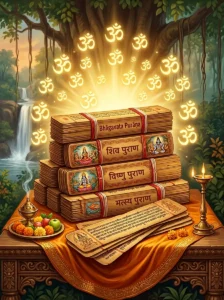
The Purāṇās are among the most sacred, expansive, and transformative bodies of knowledge bestowed upon humanity. They are not mere “books” or “texts” in the ordinary sense — they are living streams of divine revelation, flowing from the supreme consciousness of Bhagavān through the lineage of Rishis, and compiled for the welfare of all beings by the great Kṛṣṇa Dvaipāyana Veda Vyāsa.
If the Vedas are the breath of Bhagavān, the Purāṇās are His heartbeat — rhythmic, all-pervading, and life-sustaining. They carry the eternal truths of the Vedas into the hearts and homes of every person, regardless of their station, qualification, or stage of life.
The Meaning and Etymology of “Purāṇa”
The word Purāṇa is derived from the Sanskrit root purā (ancient, of old) combined with nava (ever-new), yielding the meaning: “that which is ancient yet ever-new.” This is not a paradox but a profound spiritual truth. The knowledge contained in the Purāṇās is beginningless (anādi), for it describes the nature of Brahman, the cycles of creation, and the eternal Dharma — truths that do not age, decay, or become obsolete.
The Vāyu Purāṇa itself explains:
purā pūrvam anati jīvati iti purāṇam — “That which lives from ancient times is a Purāṇa.”
Another traditional etymology given is:
purā api navam iti purāṇam — “Though ancient, it is ever-fresh.”
This dual nature is central to understanding the Purāṇās. They speak of events that occurred in yugas long past, yet their teachings on Dharma, Bhakti, Jñāna, and Vairāgya remain as relevant today as they were when first revealed.
The Divine Origin of the Purāṇās
The Purāṇās are not human compositions. They are apauruṣeya in spirit — originating from the divine will of Bhagavān and transmitted through an unbroken chain of celestial and sage-narrators.
The Matsya Purāṇa and the Viṣṇu Purāṇa both describe that at the time of creation, the Purāṇa-Saṃhitā arose from the breath of Mahā Viṣṇu alongside the four Vedas. The Bhāgavata Purāṇa (3.12.39) records that Brahmā brought forth the Purāṇās along with the Vedas from his different faces as part of the primordial act of Sṛṣṭi. In the Atharva Veda (11.7.24), the Purāṇas and Itihāsas are mentioned together with the Ṛk, Sāma, Yajus, and Chandas, affirming their Vedic status.
Thus, the Purāṇās are not later additions or supplementary compositions — they are co-eternal with the Vedas, arising from the same divine source and serving the same ultimate purpose: to lead all beings toward Mokṣa.
Vedavyāsa — The Compiler and Arranger
In every Dvāpara Yuga, the single body of Vedic knowledge is divided and arranged for the benefit of the beings of the coming Kali Yuga, whose diminished capacities make it difficult to comprehend the vast, unified corpus. The divine personality who performs this sacred task is known as Vyāsa — literally, “the arranger” or “the divider.”
In the present Vaivasvata Manvantara, in the twenty-eighth Dvāpara Yuga, this role was fulfilled by Kṛṣṇa Dvaipāyana, the son of Maharṣi Parāśara and Satyavatī. Born on an island (dvīpa) in the Yamunā, dark-complexioned (kṛṣṇa), he came to be known as Kṛṣṇa Dvaipāyana. After dividing the one Veda into four — Ṛg, Yajus, Sāma, and Atharva — and teaching each to his disciples (Paila, Vaiśampāyana, Jaimini, and Sumantu respectively), he composed the great Mahābhārata and then compiled the Purāṇa-Saṃhitā, organizing the vast body of Purāṇic knowledge into eighteen Mahā Purāṇās and numerous Upa Purāṇās.
It is important to understand that Vyāsa did not “author” the Purāṇās in the way a modern writer creates a novel. He compiled, arranged, and presented the eternal knowledge that already existed in the divine realm, making it accessible to humanity. As the Viṣṇu Purāṇa (3.4.2-5) states, the Purāṇa-Saṃhitā was originally one unified body of knowledge. Vyāsa divided it into eighteen parts and taught it to his disciple Romaharṣaṇa (also called Lomaharṣaṇa), a Sūta by birth, who in turn taught it to his six disciples — Sumati, Agnivarcas, Mitrāyu, Śāṃśapāyana, Akṛtavraṇa, and Sāvarṇi — from whom the various recensions of the Purāṇās descended.
Why the Purāṇās Were Revealed
The Śrīmad Bhāgavata Purāṇa (1.4.25) narrates a deeply moving account. After completing the monumental task of dividing the Vedas and composing the Mahābhārata, Bhagavān Veda Vyāsa sat on the banks of the Sarasvatī river and felt a profound dissatisfaction within his heart. Despite having accomplished what no other sage could, he felt incomplete. It was at this juncture that his Guru, the divine Nārada Muni, appeared and revealed the reason for this discontent: Vyāsa had not yet sufficiently glorified the transcendental Līlā and divine qualities of Bhagavān Śrī Hari in a manner that could directly awaken Bhakti in the hearts of all beings.
Inspired by Nārada’s instruction, Vyāsa then composed the Śrīmad Bhāgavata Mahā Purāṇa — the ripened fruit of the Vedic wish-fulfilling tree — and in doing so, brought the entire Purāṇic corpus to its spiritual zenith.
This episode reveals the core purpose of the Purāṇās: they exist not merely to convey information, but to transform the heart, to awaken devotion, to illuminate the path of Dharma, and to grant the ultimate fruit of human life — loving communion with the Supreme.
The Five Distinguishing Characteristics (Pañca Lakṣaṇa)
The traditional definition of a Purāṇa, found in the Matsya Purāṇa, Viṣṇu Purāṇa, and several other texts, identifies five characteristic subjects (Pañca Lakṣaṇa) that a Purāṇa must address:
- Sarga (Primary Creation): The original projection of the universe from Brahman; the emergence of the Mahat-tattva, Ahaṅkāra, Tanmātrās, Bhūtās, Indriyās, and all subtle and gross elements from the unmanifest Prakṛti under the will of Īśvara.
- Pratisarga (Secondary Creation / Dissolution and Re-creation): The cyclical process of destruction and re-creation of worlds at the end of each Kalpa, Manvantara, or Yuga; also the re-creation that follows each Pralaya, including the stories of the great floods and the reconstitution of life.
- Vaṃśa (Genealogy of Devas and Rishis): The lineages of the Devatās, Prajāpatis, Manus, and the great Ṛṣi families, tracing the descent of divine and saintly beings from the beginning of creation.
- Manvantara (The Epochs of the Manus): The description of the fourteen Manvantaras within each Kalpa, each presided over by a Manu, a set of Saptarṣis, an Indra, and an Avatāra of Bhagavān Viṣṇu, detailing the Dharma, rulers, and events of each epoch.
- Vaṃśānucarita (Dynastic Histories): The detailed accounts of the Sūrya Vaṃśa, Chandra Vaṃśa, and other royal dynasties, including the lives, deeds, and dharmic conduct of kings, queens, and their descendants.
Some Purāṇās, particularly the Bhāgavata, expand this framework to ten characteristics (Daśa Lakṣaṇa), adding:
- Sthāna (The Sustaining Ground): The shelter of all beings in Bhagavān; how the Lord sustains and protects all creation.
- Pōṣaṇa (Nourishment / Grace): The nurturing compassion of Bhagavān toward His devotees and all beings.
- Ūti (Motivating Force): The propelling impulse behind all actions, rooted in the Lord’s Saṅkalpa.
- Iśānukathā (Narratives of the Lord and His Devotees): The sacred stories of Avatāras, Bhaktas, and their transformative interactions.
- Nirodha (Dissolution): The drawing back of all beings and creation into the Supreme at the time of Mahā Pralaya.
These characteristics ensure that each Purāṇa is not a random collection of stories, but a structured, cosmologically grounded, and spiritually purposeful scripture.
The Eighteen Mahā Purāṇās
The Purāṇic tradition itself records the list of eighteen Mahā Purāṇās in several places, including the Matsya Purāṇa, the Viṣṇu Purāṇa, and the Śrīmad Bhāgavata Purāṇa (12.13.4–9). The celebrated verse that enumerates them uses the first syllables as a mnemonic:
ma-dvayaṃ bha-dvayaṃ caiva bra-trayaṃ va-catuṣṭayam a-nā-pa-liṅ-ga-kū-skāni purāṇāni pṛthak pṛthak
This yields the eighteen Purāṇas as starting with:
- Ma — Matsya, Mārkaṇḍeya;
- Bha — Bhāgavata, Bhaviṣya;
- Bra — Brahma, Brahmāṇḍa, Brahma Vaivarta;
- Va — Viṣṇu, Vāyu, Vāmana, Varāha;
- A — Agni;
- Nā — Nārada;
- Pa — Padma;
- Liṅ — Liṅga;
- Ga — Garuḍa;
- Kū — Kūrma;
- Ska — Skanda.
Together, the eighteen Mahā Purāṇās comprise approximately four hundred thousand verses (catur-lakṣa ślokāḥ), a vast ocean of sacred knowledge.
The Tri-Guṇa Classification
The Padma Purāṇa (Uttara Khaṇḍa, 236.18–21) classifies the eighteen Mahā Purāṇās according to the three Guṇas of Prakṛti:
Sāttvika Purāṇās — Those that predominantly praise Bhagavān Viṣṇu, leading the devotee toward purity, knowledge, and liberation. These include the Viṣṇu, Bhāgavata, Nārada, Garuḍa, Padma, and Varāha Purāṇās.
Rājasika Purāṇās — Those that predominantly praise Brahmā and deal with themes of creation, activity, and desire. These include the Brahma, Brahmāṇḍa, Brahma Vaivarta, Mārkaṇḍeya, Bhaviṣya, and Vāmana Purāṇās.
Tāmasika Purāṇās — Those that predominantly praise Śiva and Agni, dealing with themes of dissolution, austerity, and the destruction of ignorance. These include the Śiva (Vāyu), Liṅga, Skanda, Agni, Matsya, and Kūrma Purāṇās.
This classification should not be misunderstood as a hierarchy of superiority or inferiority. All eighteen Mahā Purāṇās are sacred and authoritative. The Guṇa classification indicates the predominant adhikāra (eligibility and inclination) of the seeker — a devotee drawn to Sattva will naturally gravitate toward the Sāttvika Purāṇās, while one whose temperament is Rājasika or Tāmasika will find their path illumined by the corresponding Purāṇās. Bhagavān, in His infinite compassion, has provided a pathway suited to every temperament, ensuring that no Jīva is left without guidance.
Furthermore, it must be remembered that all the Purāṇās ultimately lead the seeker toward the same Supreme Truth. Whether they glorify Viṣṇu, Śiva, or Devī, the Purāṇās are unanimous in affirming the non-dual nature of the Supreme and the supremacy of Bhakti as the means to liberation.
The Upa Purāṇās
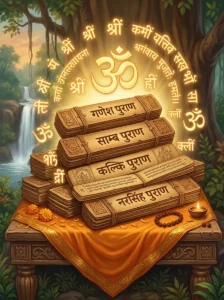
In addition to the eighteen Mahā Purāṇās, the tradition recognizes a parallel set of eighteen Upa Purāṇās (supplementary Purāṇās). These are attributed to various Rishis and expand upon themes introduced in the Mahā Purāṇās. Different Purāṇas give slightly varying lists of the Upa Purāṇās, but commonly cited ones include the Sanatkumāra, Narasiṃha, Nāndi, Śivadharma, Durvāsas, Kāpila, Mānavā, Auśanasa, Varuṇa, Kālikā, Sāmba, Saura, Āditya, Mahēśvara, Devī Bhāgavata, Vasiṣṭha, Viṣṇudharmottara, and Gaṇeśa Purāṇās. Among these, the Devī Bhāgavata Purāṇa and the Gaṇeśa Purāṇa hold especially exalted positions in their respective Sampradāyas.
The Purāṇās as the Fifth Veda
A question that sometimes arises is the relationship between the Purāṇās and the Vedas. The tradition is unequivocal on this matter. The Chāndogya Upaniṣad (7.1.2) records Nārada approaching Sanatkumāra and listing the bodies of knowledge he has studied, explicitly including “Itihāsa-Purāṇaṃ Pañcamam Vedānāṃ” — “the Itihāsas and Purāṇās are the fifth Veda.”
The Bṛhadāraṇyaka Upaniṣad (2.4.10) similarly affirms that the Itihāsas and Purāṇās emerged from the breath of the Mahad-Bhūta (the Great Being) alongside the Ṛg, Yajus, and Sāma Vedas.
The Gopatha Brāhmaṇa also states:
itihāsa-purāṇābhyām vedaṃ samupabṛṃhayet — “One should supplement and strengthen one’s understanding of the Vedas through the Itihāsas and Purāṇās.”
This principle is of paramount importance. The Vedas, being highly condensed, symbolic, and esoteric in their language, are difficult for most people to understand directly. The Purāṇās illuminate the Vedic truths through stories, dialogues, historical narratives, and practical instructions. They do not replace the Vedas but make them accessible. A beautiful analogy given in the tradition is:
itihāsa-purāṇābhyāṃ vedaṃ samupabṛṃhayet
bibhety alpa-śrutād vedo mām ayaṃ pratarishyati“The Veda fears the person of little learning, thinking, ‘This one will distort my meaning.’ Therefore, one must approach the Vedas supported by the Itihāsas and Purāṇās.”
This remarkable verse, found in multiple sources, personifies the Veda itself as being anxious about being misinterpreted by those who lack the broader context that the Purāṇās provide. It underscores the indispensable role of the Purāṇās in the correct understanding and application of Vedic Dharma.
The Scope and Content of the Purāṇās
The Purāṇās are nothing short of a complete encyclopedia of Sanātana Dharma. Their scope encompasses:
Cosmology and Cosmography — Detailed descriptions of the fourteen Lokas (Bhūḥ, Bhuvaḥ, Svaḥ, Mahaḥ, Janaḥ, Tapaḥ, Satyam, Atala, Vitala, Sutala, Talātala, Mahātala, Rasātala, Pātāla), the structure of Brahmāṇḍa, the arrangement of Dvīpas and Samudras, the movements of celestial bodies through Jyotiṣa-based frameworks, and the nature of time from the Truti to the Para.
Theology and Philosophy — Expositions on the nature of Brahman, Paramātmā, and Bhagavān; the Jīva’s journey through Saṃsāra; the mechanics of Karma, Punarjanma (rebirth), and Mokṣa; the various paths of liberation — Jñāna, Karma, Bhakti, and Yoga; and the nature and glory of the divine Avatāras.
Dharmaśāstra — Detailed codes of righteous conduct for individuals, families, communities, and rulers; the duties associated with Varṇa and Āśrama; the Saṃskāras from conception to death; the principles of Rāja Dharma (governance); the ethics of war, trade, and social interaction.
Tīrtha Māhātmya — Descriptions of sacred places, rivers, mountains, and temples across Bhārata-varṣa and beyond, including the spiritual merit gained by pilgrimage, bathing, and worship at these sites.
Vrata and Utsava — Detailed instructions on sacred vows, fasts, festivals, and observances throughout the Hindu calendar, including the specific Devatā to be worshipped, the mantras to be chanted, the procedures to be followed, and the fruits to be attained.
Stotras and Mantras — Some of the most beloved hymns of Sanātana Dharma are found within the Purāṇās, including the Viṣṇu Sahasranāma (in the Mahābhārata, closely linked to Purāṇic tradition), the Śiva Sahasranāma, the Lalitā Sahasranāma (in the Brahmāṇḍa Purāṇa), and countless other Stotras that form the daily worship of millions.
Ākhyāna and Upākhyāna — Grand narratives and sub-narratives that convey moral, spiritual, and philosophical truths through captivating storytelling — the deeds of Avatāras, the trials and triumphs of Bhaktas, the interactions between Devas and Asuras, and the consequences of Dharma and Adharma played out across cosmic time.
Yoga, Sāṅkhya, and Tantra — Several Purāṇas contain detailed expositions of Yogic practices, the Sāṅkhya enumeration of Tattvas, Kuṇḍalinī Yoga, Mantra Śāstra, and Tāntric worship, making them invaluable resources for sādhakas of all paths.
Āyurveda, Jyotiṣa, and other Vidyās — The Agni Purāṇa, Garuḍa Purāṇa, and others contain substantial sections on medicine, astrology, architecture (Vāstu), gemology, grammar, poetics, and the arts, reflecting the holistic vision of knowledge in the Vedic worldview where no domain of life is separate from Dharma.
The Unique Narrative Structure
One of the most distinctive and beautiful features of the Purāṇās is their layered narrative structure. Unlike modern books with a single author and a linear voice, the Purāṇās present knowledge through nested dialogues spanning multiple planes of existence.
A typical pattern might be: Sūta narrates to the assembled Rishis at Naimiṣāraṇya, recounting what Vyāsa taught Śaunaka and others, who in turn heard it from a Devatā who had received it from Bhagavān Himself. Within this frame, individual characters — Rishis, kings, celestial beings — narrate their own experiences, creating a tapestry of voices that enriches the teaching.
This is not mere literary technique. It establishes the Rishi Paramparā (lineage of transmission), assuring the listener that the knowledge has passed through trustworthy hands. It also reflects the Vedic understanding that knowledge is not the property of any individual — it flows downward from the Supreme through successive levels of being, reaching humanity through the grace of the Guru and the tradition.
The setting of Naimiṣāraṇya — the sacred forest where the Rishis gathered to hear Sūta’s recitation during a great Sattra (sacrificial session) — is itself significant. It represents a timeless, sanctified space where the highest truths are shared in an atmosphere of tapasyā, śraddhā, and mutual reverence.
The Purāṇās and Bhakti
While the Purāṇās address every dimension of Dharma, their supreme contribution is the establishment and glorification of Bhakti — loving devotion to Bhagavān — as the most accessible and most powerful means of liberation in Kali Yuga.
The Bhāgavata Purāṇa declares:
kaler doṣa-nidhe rājann asti hy eko mahān guṇaḥ
kīrtanād eva kṛṣṇasya mukta-saṅgaḥ paraṃ vrajet
“In this ocean of faults that is the age of Kali, there is one great virtue: simply by chanting the names of Kṛṣṇa (Kīrtana), one can become free from all bondage and attain the Supreme.”
Every Purāṇa, whether Sāttvika, Rājasika, or Tāmasika, ultimately directs the seeker toward Bhagavān. The stories of Dhruva, Prahlāda, Gajendra, Ajāmila, the Gopīs of Vrindāvana, and countless other Bhaktas found in the Purāṇās are not mere tales — they are living templates of surrender, devotion, and divine grace that have inspired billions of souls across the ages.
The Purāṇās democratized spirituality. In an age when direct Vedic study was becoming increasingly difficult, the Purāṇās opened the floodgates of divine knowledge to all — women, Śūdras, and those of every background — affirming that Bhakti transcends all social boundaries and that the Lord’s grace is available to everyone who turns to Him with a sincere heart.
The Purāṇās in Daily Life
It would be incomplete to speak of the Purāṇās without acknowledging their immense and pervasive influence on the daily life, culture, and spiritual practice of Hindu society. Virtually every aspect of a Hindu’s life is shaped by the Purāṇās:
The festivals that mark the Hindu calendar — Navarātrī, Dīpāvalī, Janmāṣṭamī, Mahāśivarātrī, Gaṇeśa Chaturthi, Rāma Navamī — all find their origin, meaning, and ritual framework in the Purāṇās. The temples that dot the sacred landscape of Bhārata, from the twelve Jyotirliṅgas to the 108 Divya Desams, are sanctified and explained by Purāṇic narratives. The names that Hindu parents lovingly give their children — Rāma, Kṛṣṇa, Śiva, Pārvatī, Lakṣmī, Gaṇeśa — come from the Purāṇās. The values of Dharma, Satya, Ahiṃsā, Dayā, and Dāna that form the moral bedrock of Hindu civilization are taught, illustrated, and reinforced through Purāṇic stories.
In homes across the world, the Purāṇās continue to be read, recited, and shared. The tradition of Purāṇa Śravaṇa — listening to Purāṇic recitation from a learned Paṇḍita or Bhāgavatār — remains one of the most beloved and spiritually potent practices in Hinduism. The Saptāha tradition, where the Śrīmad Bhāgavatam is recited over seven days, draws millions of devotees and is considered a direct means of attaining Bhagavat-Sākṣātkāra (realization of God).
A Prayer
The Purāṇās are not relics of a bygone era. They are eternal scriptures, pulsating with the living presence of Bhagavān, speaking to every generation with freshness and urgency. In an age marked by confusion, materialism, and the erosion of Dharma, the Purāṇās offer what the world most desperately needs — a comprehensive, compassionate, and liberating vision of reality rooted in the Supreme.
May the study of the Purāṇās bring light to our minds, devotion to our hearts, and Dharma to our actions. May Bhagavān Vedavyāsa, the great compiler of this sacred wisdom, bless all seekers with the understanding and faith needed to receive these teachings.
vyāsaṃ vasiṣṭha-naptāraṃ śakteḥ pautram akalmaṣam
parāśarātmajaṃ vande śukatātaṃ taponidhim
“I bow to Vyāsa, the grandson of Vasiṣṭha, the great-grandson of Śakti, the sinless son of Parāśara, the father of Śuka, and the treasury of austerity.”