Pativratās, A Devoted Spouse
In the ethos of Sanātana Dharma, a Pativratā is not merely a “loyal wife” in a social or contractual sense, but a spiritual powerhouse whose singular focus (Ekāgratā) on her husband transforms her consciousness into a vessel of immense cosmic power. The term is derived from Pati (husband/Lord) and Vrata (sacred vow), signifying a woman who has made her marital life a path of Yoga.
Far from being a role of subjugation, the status of a Pativratā represents the ultimate agency of a woman—where her internal will and purity are so potent that they can command the laws of nature, challenge the Devas, and even stall the movement of time.
The Metaphysics of Pativratya
In Vedic thought, the Pativratā is the human manifestation of Śakti (Energy) in union with Śiva (Consciousness). Her significance is rooted in the following principles:
- Sovereignty of Will: She is the architect of her own spiritual destiny, choosing to channel her entire being into a single relationship as a method of realizing the Divine.
- The Power of Tapas: Her daily life is considered a form of Tapasya (austerity). This discipline generates a spiritual heat (Tejas) that provides a protective shield over her family and the entire kingdom.
- Moral Superiority: In the Purāṇas, the purity of a Pativratā is often shown to exceed the ritual power of great Rishis, proving that lived devotion is superior to mere scholarship.
Epitomes of Strength and Wisdom
The tradition highlights women who were not passive followers, but leaders of their own spiritual and intellectual domains:
- Madālasā: A queen who possessed such high realization that she sang the secrets of the Atman to her children as lullabies, ensuring they became enlightened beings rather than mere worldly kings.
- Anasūyā: Her purity was so formidable that when the Trimūrti (Brahmā, Viṣṇu, and Śiva) came to test her, she used her power to transform the supreme deities into infants, demonstrating her mastery over the cosmic forces.
- Sāvitrī: A symbol of intellectual and spiritual courage who engaged Yama (the Lord of Death) in a philosophical debate and, through her wit and devotion, successfully reclaimed her husband’s life from the claws of time.
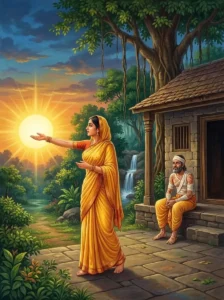
- Sumati: A woman whose devotion was so intense that she famously commanded the Sun not to rise, halting the entire universe to protect her husband.
High Regard in the Śāstras
The respect afforded to such women in Sanātana Dharma is unparalleled:
- Divine Status: Devas themselves are wary of offending a Pativratā, as her “curse” or “blessing” is infallible due to her absolute alignment with Truth.
- Ritual Centrality: No Vedic sacrifice (Yajña) is considered complete or effective without the presence of the wife (Saha-dharmini), acknowledging her as the vital energy that fuels the ritual.
- Foundation of Culture: The Pativratā is viewed as the “Gṛhalakṣmī”—the prosperity of the home. Her happiness and honor are seen as the barometers for the prosperity of the entire society.
“Where women are honored, there the Devas are pleased; but where they are not honored, no sacred rite yields rewards.” — Manu Smṛti
Modern Perspective: The Strength of Choice
While often misunderstood through a modern lens, the path of the Pativratā is the epitome of self-directed purpose. She does not seek validation from the external world but finds infinite power in her chosen focus. This path demonstrates that a woman’s strength lies in her capacity for immense love, her intellectual depth to guide future generations, and a spirit so refined that the universe itself bows to her resolve.