
Svārocisha Manvantara
Svārocisha Manvantara · svārocisha manu-antara, “the age of the Manu Svārocisha”
Susheṇa has other meanings too: see all meanings of Susheṇa.
A manvantara is one of the fourteen long ages that make up a kalpa. Each has its own Manu, its own Indra, its own devas and its own Saptarshis. The Svārocisha Manvantara is the second of them, after the Svāyambhuva Manvantara and before the Uttama Manvantara. Its Manu is Svārocisha, also called Dyutimat. Its devas are the Tushitas and the Pārāvatas, twenty-four in all, drinkers of soma, and its Indra is Vipaścit. The Mārkaṇḍeya Purāṇa names the Saptarshis as Ūrja, Stamba, Prāṇa, Dattoli, Ṛshabha, Niścara and Carvavīra; the Vāyu and Brahmāṇḍa Purāṇas give them as sons of the ṛshis of the age before, with small differences in the names. The Manu’s sons, Caitra, Kimpurusha and the others, guarded the earth for the whole manvantara. The Brahmāṇḍa Purāṇa counts this Manu among the five mind-born sons (mānasa-putras) of Brahmā, and both it and the Vāyu Purāṇa teach that the four pillars of every manvantara are the Saptarshis, the Manu, the devas and the pitṛs.
Mārkaṇḍeya tells Kraushṭuki how the Manu came to be born: from the steadfast brāhmaṇa Pravara and the apsarā Varūthinī, through the Gandharva Kali, came Svaroci, who married Manoramā, Vibhāvarī and Kalāvatī and at last fathered the Manu by the devī of the forest, at the wish of the devas. Whoever hears the deeds of Svaroci and the birth of Svārocisha with śraddhā is freed from pāpa. The Vāmana Purāṇa tells how the seven Maruts of this age were born: Indra sent the apsarā Pūtanā to break the tapas of the seven sons of Kratudhvaja, the Manu’s son; their seed fell into a river and was swallowed by the crocodile Śaṅkhinī, whose seven infants Brahmā made the Maruts. In the Agni Purāṇa, Agni Deva names the same devas, Indra Vipaścit and the sons Caitra and Kiṃpurusha, and says that in this manvantara Śrī Mahāvishṇu descended as the aṃśāvatāra Ajita; Svārocisha is also among the fourteen Manus called on to protect a king at his abhisheka.
The Bhāgavata Purāṇa calls Svārocisha the son of Agni and names his sons Dyumat, Susheṇa and Rocishmat. In its account Rocana is Indra, the Tushitas and Pārāvatas are the devas, and Ūrjastambha, Ūrja and others, knowers of Brahman, are the saptarshis; and Bhagavān Vishṇu took avatāra as Vibhu, son of the maharshi Vedaśiras and Tushitā, a lifelong brahmacārī from whom eighty-eight thousand maharshis learned the vrata of brahmacarya.
The Bhavishya Purāṇa sets the burning of Kāma in this manvantara: Bhagavān Śaṅkara, answering the prayer of Rati, names it as the Svārocisha manvantara and promises her Pradyumna in the Vaivasvata manvantara.
The Brahma Purāṇa names the Tushitas as the devas in the time of Svāroci Manu, with Urva, Stamba, Kaśyapa, Bṛhaspati, Atri, Cyavana and others as the ṛshis, and sets in this manvantara the creation of all beings from Kaśyapa and the daughters of Daksha.
Each of the people in the account of Svaroci’s line below has a full page of their own. Below is a short account of each, with a link to the full page. The whole Mārkaṇḍeya account, and the accounts of the Vāyu, Brahmāṇḍa, Vāmana and Agni Purāṇas, are on pages of their own, summarised at the end.
The ancestry of Svārocisha Manu
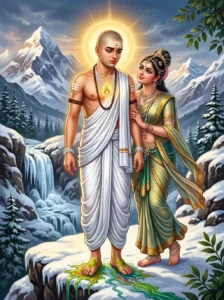
Pravara, Grandfather of Svarocisha Manvantara
Pravara was a peaceful brāhmaṇa of the village of Aruṇāspada on the bank of the Varuṇā river. He was more handsome than the Aśvinīkumāras, studied the Veda and Vedāṅgas, was spotless in character and always welcomed guests. He wished only to see the forests, cities and holy places of the earth.
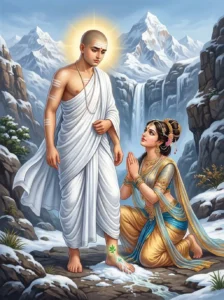
A guest learned in mantras and herbs put a paste of herbs on his feet that let him travel thousands of yojanas in a few hours, and Pravara went to the Himālaya. There the snow washed the paste away and he was stranded, afraid only that his daily rites and his service of the sacred fires would be broken.
The apsarā Varūthinī saw him and begged him to stay with her, offering divine clothes, food and unending youth. Pravara held to his dharma. He prayed to Gārhapatya Agni: if he had never desired another’s wealth or wife, let the fire help him. Agni entered his body as a light, and in a moment he was home in Aruṇāspada, continuing his rites as before. Later the Gandharva Kali took Pravara’s form, and from this Svaroci was born.
Varūthinī
Varūthinī was a famous apsarā who lived among the peaks of the Himālaya with the siddhas and Gandharvas, with a complexion like the inside of a lotus. When she saw the stranded brāhmaṇa Pravara, she was struck by kāma for his beauty and tejas and begged him to stay with her.
Pravara refused her for his dharma and, by his prayer to Gārhapatya Agni, was carried away in a light, leaving her alone and grieving. The Gandharva Kali, whom she had once rejected, then took the exact form of Pravara. Believing her beloved had returned, she agreed to keep her eyes closed during their union. Because she meditated deeply all the while on the tejas of the true brāhmaṇa, the son she bore shone like Sūrya: he was Svaroci, father of Svārocisha Manu.
Svaroci, Father of Svarocisha Manu
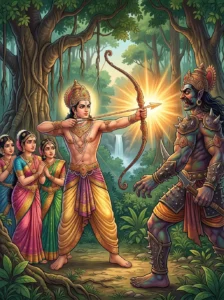
Svaroci, “he who shines by his own tejas”, was the son of Varūthinī and the Gandharva Kali in Pravara‘s form. He grew up on Mount Mandara, master of the four Vedas, the śāstras and Dhanurveda. There he saved Manoramā from a rākshasa; she gave him an astra that had passed from Bhagavān Rudra to Svāyambhuva Manu, and the rākshasa, facing it, turned back into her father Indīvarāksha, who gave her to Svaroci in marriage and taught him the whole of ashṭāṅga Āyurveda.
With that knowledge he healed Manoramā’s friends Vibhāvarī and Kalāvatī and married them too. Vibhāvarī gave him the knowledge of the speech of all beings, and Kalāvatī the Padminī vidyā that made the eight nidhis (treasures) obey him. He built three cities for his three sons: Vijaya in the east for Manoramā’s son Vijaya, Nandavatī in the north for Vibhāvarī’s son Merunandana, and Tāla in the south for Kalāvatī’s son Prabhāva.
Hearing a cakravāka bird and a deer mock his life with many wives, he felt detachment, though kāma held him for centuries more. A doe begged him to embrace her; she became the devī of the forest and told him the devas wished a Manu to be born of them. Their son shone so brightly that Svaroci named him Dyutimān: he became Svārocisha Manu. At last, taught by the words of a haṃsa on the bondage of family and pleasure, Svaroci went to the tapovana with his three wives, performed tapas and rose to svarga.
Svaroci’s wives and their families
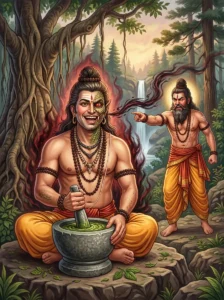
Indīvarāksha, A Vidyādhara
Indīvarāksha was a noble vidyādhara, son of Khaṅgīnalanābha and father of Manoramā. He longed to master Āyurveda, but the Ṛshi Brahmamitra saw his lack of humility and refused him. He hid nearby, listened to the lessons given to the other students, and learned all eight parts of Āyurveda in eight months.
In his pride he laughed at the Ṛshi. Brahmamitra, seeing that he had taken knowledge like a thief, gave him a śāpa to become a rākshasa in seven nights. When Indīvarāksha fell at his feet, the Ṛshi told him he would forget himself and even attack his own daughter, but would remember who he was when he faced the power of an astra.
So it happened: as a rākshasa he chased Manoramā on Mount Mandara and was about to devour her when Svaroci raised the Pracaṇḍāstra. Seeing its light he remembered himself and became a vidyādhara again, in divine ornaments. In gratitude he gave Manoramā to Svaroci as his wife, taught him the complete ashṭāṅga Āyurveda, and returned in a divine vimāna to his home.
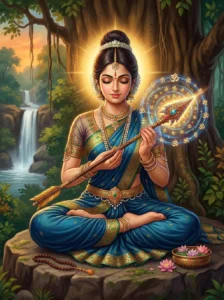
Manoramā, Wife of Svaroci
Manoramā was a vidyādharī, daughter of Indīvarāksha and Marudhanvā, and the friend of Vibhāvarī and Kalāvatī. On a lake on Mount Kailāsa she laughed at a ṛshi worn thin by tapas, and he gave her a śāpa that a rākshasa would seize her; when her friends spoke against him, he gave them śāpas of painful disease.
For three days the rākshasa hunted her through the mountains, until on Mount Mandara she met Svaroci and took refuge in him. She gave him a secret astra, first given by Bhagavān Rudra to Svāyambhuva Manu, and taught him its mantras. Facing it, the rākshasa revealed that he was her own father Indīvarāksha, under the śāpa of Brahmamitra, and was restored.
Her father gave her to Svaroci, whom she had loved at first sight, but she would not be happy while her friends still suffered. Svaroci healed them with his Āyurveda soon after the wedding. Manoramā lived with him on the mountain peaks and bore him a son, Vijaya.
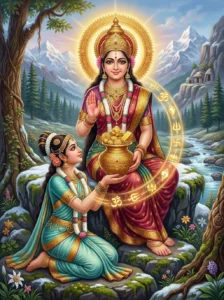
Kalāvatī, Wife of Svaroci
Kalāvatī was the daughter of the brahmarshi Pāru (Pāra) and the apsarā Puñjikasthalā. Her mother left her alone as a baby in a forest full of wild beasts. Each day of the śukla paksha (the waxing fortnight of the moon) she grew in strength and beauty like the moon’s light, yet never waned in the kṛshṇa paksha, and so she was named Kalāvatī.
When her guardian refused to give her in marriage to a suitor, he was killed. Alone and in despair, she was about to give up her life when Devī Satī appeared and stopped her. Satī foretold that she would marry Svaroci and that their son would be a Manu, and gave her the Padminī vidyā, by which the eight nidhis obey her.
Under a muni’s śāpa she suffered from kshaya-roga (consumption) until Svaroci came and cured her with his Āyurveda. She married him, shared her treasures and powers with him, lived with him on the mountain and bore him a son, Prabhāva.
The full accounts in the Purāṇas
The Birth of Svārocisha Manu in the Mārkaṇḍeya Purāṇa
The Birth of Svārocisha Manu in the Mārkaṇḍeya Purāṇa gives Mārkaṇḍeya‘s whole account to Kraushṭuki (Chapters 58–64), from Pravara of Aruṇāspada on Himavat to Svarocis’s tapas with his wives. It tells, among much else, that Varūthinī was the daughter of Muli; that the astra Manoramā gave Svarocis, the Heart of all weapons, passed from Rudra to Svāyambhuva Manu, to Vasishṭha, to Citrāyudha, her mother’s father, and to her father Indīvara as a wedding gift; that Indīvara, son of Nala-nābha, king of the Vidyādharas, learned the Āyurveda from Brahma-mitra while invisible; that Vibhāvarī was the daughter of the Vidyādhara Mandāra and gave Svarocis the speech of all beings; that Kalāvatī‘s father Pāra refused a Gandharva her hand and died by that Gandharva’s śāpa; and that Svarocis gave his son Vijaya the city Vijaya on a hill in Kāmarūpa. It gives the words of the goose and the hen-cakravāka, the buck, and the duck and his mate that turned Svarocis from pleasure, the reign of Svārocisha Manu with its devas, Indra and seven ṛshis, and the phalaśruti.
The Svārocisha Manvantara in the Vāyu and Brahmāṇḍa Purāṇas
The Svārocisha Manvantara in the Vāyu and Brahmāṇḍa Purāṇas gives both lists in full. The Vāyu Purāṇa names the Saptarshis by family, Ūrja son of Vasishṭha, Stambha, Droṇa, Ṛshabha, Dattātri, Niścala and Nidhāvanta, and the Manu‘s nine sons, Caitra, Kavi, Uta, Kṛtānta, Vibhṛta, Ravi, Bṛhattu, Guha and Nava. The Brahmāṇḍa Purāṇa names the twelve Tushitas, sons of Kratu Ṛshi, and the twelve Pārāvatas, gives six Saptarshis by family (Ūrja, Stambha, Prāṇa, Datta, Niścala Ātreya and Arvarīvān), and names nine sons, Caitra, Kimpurusha, Kṛtānta, Vibhṛta, Ravi, Bṛhadukta, Nava, Setu and Śruta. Both teach the four pillars of every manvantara and which people come from each.
The Svārocisha Manvantara in the Vāmana and Agni Purāṇas
The Svārocisha Manvantara in the Vāmana and Agni Purāṇas tells in full, from Chapter 46 of the Vāmana Purāṇa, how Indra sent Pūtanā to Mahāmeru, how fishermen caught the crocodile Śaṅkhinī, wife of the makara Mahāśaṅkha, and how the princes let her go into the well of their house, where she bore the seven infants whom Brahmā set on the path of the wind. From the Agni Purāṇa it gives the aṃśāvatāras of the first seven manvantaras, from Mānasa to Vāmana, the work of every manvantara, and the full list of the devatās called on at a king’s abhisheka (Chapters 150, 219).
Per Bhāgavata Purāṇa
In Skandha 8 of the Bhāgavata Purāṇa, Parīkshit Mahārāja asks Śuka Maharshi to tell him of the Manus after Svāyambhuva and of the avatāras and līlās of Śrī Hari in each manvantara. Śuka names the second Manu as Svārocisha, the son of Agni. His sons were Dyumat, Susheṇa, Rocishmat and others. In that manvantara Rocana was Indra; the Tushitas, the Pārāvatas and others were the devas; and Ūrjastambha, Ūrja and others, knowers of Brahman, were the saptarshis.
The maharshi Vedaśiras had a wife famed as Tushitā. To him, in her, Bhagavān Vishṇu took avatāra and became famous by the name Vibhu. Vibhu remained a naishṭhika brahmacārī (one who keeps brahmacarya for life) from childhood, and eighty-eight thousand maharshis learned that vrata of brahmacarya from him and kept it.
In Skandha 4, Maitreya tells Vidura that Aṅgiras and Śraddhā had two sons, Utathya, established in brahman, and Bṛhaspati, and that both became famous in the Svārocisha manvantara.
Source: Bhāgavata Purāṇa, Skandha 4, Chapter 1; Skandha 8, Chapter 1
Per Bhavishya Purāṇa
Bṛhaspati tells Devendra that the burning of Kāma took place in this manvantara. After the vivāha of Bhagavān Śiva and Devī Pārvatī, Bhagavān Śiva came to Kailāsa with her and remained immersed in ānanda (bliss) for a thousand years. Seeing the impudence of Kāma-Pradyumna, Bhagavān Śaṅkara burned him to ash and made him Anaṅga, the bodiless.
At the prayer of his wife Rati, Bhagavān Śaṅkara said: “You will dwell in the hearts of living beings. This is the Svārocisha manvantara. In the twenty-eighth Dvāpara of the Vaivasvata manvantara you will gain as husband Pradyumna, son of Bhagavān Śrī Kṛshṇa.” Having said this, Bhagavān Śaṅkara withdrew from sight. Afterwards Kumārasvāmī Skanda was born, who slew Tārakāsura, brought peace and joy to the devas, and made svarga and the whole world secure.
Source: Bhavishya Purāṇa, Pratisarga Parva, Khaṇḍa 4, Chapter 14
Per Brahma Purāṇa
The ṛshis, devas and sons
In his telling of the manvantaras, Lomaharshaṇa, the Sūta, tells the munis that in the time of Svāroci Manu the ṛshis were Urva, Stamba, Kaśyapa, Prāṇa, Bṛhaspati, Datta, Atri and Cyavana. The devas were the seven Tushitas, devas of great vows (mahā-vrata). The sons of Svāroci were Havighna, Sukṛti, Jyoti, Āpa, Mūrti, Pratīta, Nabhasya, Nabhas and Ūrjas. “This is the matter of the second manvantara.”
Source: Brahma Purāṇa, Chapter 5
The creation of Kaśyapa
Lomaharshaṇa also tells the munis how the worlds were filled with beings from the daughters of Daksha. Of his sixty daughters, Daksha gave thirteen to Kaśyapa Prajāpati: Aditi, Diti, Danu, Arishṭā, Surasā, Khanā, Surabhi, Vinatā, Tāmrā, Krodhavaśā, Irā, Kadru and Muni. From Kaśyapa, Surabhi bore the eleven Rudras and Diti bore Hiraṇyakaśipu and Hiraṇyāksha; from him came the dānavas with Vipracitti at their head; Surabhi bore cows and buffaloes, Irā the trees, creepers and grasses, Khanā the yakshas and rākshasas, Muni the apsarases, and Arishṭā the siddhas and gandharvas. This offspring, moving and unmoving, belongs to Kaśyapa, and their grandsons and great-grandsons were born in thousands. “This is the creation that took place in the Svārocisha manvantara.”
Source: Brahma Purāṇa, Chapter 3
Sources
- Vāyu Purāṇa, Uttarārdha (Second Part), Chapter 1
- Mārkaṇḍeya Purāṇa, Chapters 58–64
- Brahmāṇḍa Purāṇa, Pūrva Bhāga (First Part)
- Vāmana Purāṇa, Chapter 46
- Agni Purāṇa, Chapters 150, 219
- Bhāgavata Purāṇa, Skandha 4, Chapter 1; Skandha 8, Chapter 1
- Bhavishya Purāṇa, Pratisarga Parva, Khaṇḍa 4, Chapter 14
- Brahma Purāṇa, Chapters 3, 5
 Indīvarāksha, A Vidyādhara
 Kalāvatī, Wife of Svaroci
 Manoramā, Wife of Svaroci
 Pravara, Grandfather of Svarocisha Manvantara
 Svaroci, Father of Svarocisha Manu
 Varūthinī