Auttama Manvantara
The Auttama Manvantara (also known as Uttara Manvantara or Uttama Manvantara) is the third manvantara in the cycle of fourteen manvantaras described in the Mārkaṇḍeya Purāṇa. It is named after Auttama, the Manu who presided over this era. Auttama was the son of King Uttama, himself a son of Uttānapāda. The narrative of this manvantara, as recounted by the sage Mārkaṇḍeya in Mārkaṇḍeya Purāṇa, traces Uttama‘s life, his intense love for his queen Bahuḷā, the trials that befell him through separation from her, and the eventual birth of Auttama, who rose to become the sovereign of the entire manvantara. The account also details the Indra, the deva gaṇas, and the Saptarshis who served during this cosmic period.
Birth of Auttama Manu
King Uttama and His Virtues
Uttama was born to Sūci, the queen of King Uttānapāda, as a son of great prowess and valor. He was renowned as a dharmātmā and a mahātmā, possessed of extraordinary might. Through his parākrama, Uttama illuminated all beings just as the sun illumines the world with its radiance. He regarded all people with equanimity, treating friends, enemies, and strangers alike with impartiality. Toward the wicked he was as fearsome as Yama, and toward the righteous he was as soothing as the moon. He governed his kingdom with justice and steadfastness, and was celebrated across the realm for his adherence to dharma.
The Marriage to Bahuḷā
Just as Indra, famed throughout all the lokas, had married Śacī Devī, so too did Uttama, the dharma knowing prince, marry the illustrious princess Bahuḷā. From the moment of their union, the king’s mind became entirely absorbed in Bahuḷā. His attachment to her was compared to the fixation of the moon upon Rohiṇī. No other woman occupied even a passing thought in his mind, not even in his dreams. Upon seeing Bahuḷā’s beautiful form, the king would become enraptured, lost in the mere act of beholding and touching her. Yet the queen, despite hearing his loving words and receiving his great reverence, felt no corresponding affection and behaved as though she regarded him with disdain.
Bahuḷā’s Indifference and the King’s Anguish
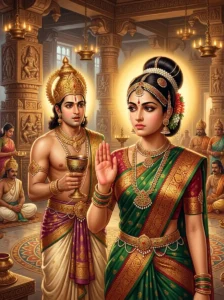
Despite the king lavishing upon Bahuḷā the finest ornaments, the most exalted seat, and every comfort, she remained cold and distant. Even when the king personally served her food and held her hand in supplication, she ate only a meager portion with a displeased heart. Day after day, the queen persisted in her hostility, yet Uttama’s love for her only deepened. On one occasion, as skilled singers performed melodious songs before the royal couple, the king, filled with affection, offered a cup of madhvī to Bahuḷā in the presence of the assembled court. But even before the entire gathering, the queen turned her face away and refused to accept the drink. Enraged like a serpent, the king summoned his doorkeeper and commanded him to take Bahuḷā to a desolate forest and abandon her there, forbidding any question of his order.
The Exile of Bahuḷā
The doorkeeper, bound by duty, obeyed the king’s command without hesitation. Declaring it the order of the sovereign, he placed the queen upon a chariot and conveyed her into the wilderness, where he left her and returned. Remarkably, even after being cast out in this manner, Bahuḷā interpreted the king’s action as a form of grace. Back in the capital, King Uttama, his heart scorched by separation, was consumed with grief. He took no other wife. Though his mind remained devoted to the memory of Bahuḷā’s beautiful form, he continued to discharge his duties as ruler, governing his subjects as a father would his own children.
The Brāhmaṇa’s Plea
During this period of quiet suffering, a brāhmaṇa arrived at the king’s court in great distress. He reported that while he slept at night, an unknown intruder had forced open his door and abducted his wife. He implored the king, as the protector of his people, to recover her. The king asked for a description: who had taken her, and where might she be found? The brāhmaṇa confessed that he did not know the identity of the abductor, but insisted that since the king received one sixth of his subjects’ earnings as tax, the responsibility of protection fell squarely upon the throne. It was because of this protection that people slept peacefully at night.
The Description of the Brāhmaṇa’s Wife
Pressed for details, the king asked the brāhmaṇa to describe his wife’s appearance so that she might be identified. The brāhmaṇa replied that his wife had a crooked nose, was neither tall nor short, had thin arms, a large belly, a slender waist, small and sunken breasts, and was altogether of a most unattractive appearance, yet he declared that he did not despise her in the least. He added that her speech and temperament were both exceedingly harsh, and that the first bloom of her youth had already passed. He offered to tell the king everything faithfully about her as she truly was.
The King’s Suggestion and the Brāhmaṇa’s Refusal
Upon hearing the description, the king suggested that the brāhmaṇa had no need for such an inauspicious wife and offered to arrange a new marriage with a woman of auspicious qualities who would bring happiness. An ill natured wife, the king argued, brought only sorrow, and it would be better to abandon one devoid of beauty and good character. The brāhmaṇa, however, rejected this counsel firmly. He explained that the ancient teaching held that a wife must be protected, for through the protection of the wife comes the protection of one’s progeny, and through progeny the protection of one’s own ātmā. If a wife were not properly guarded, varṇasaṅkara would result, causing one’s pitṛs to fall from svarga. He declared that his wife had been wedded to him before the sacred fire with the sanction of elders, and that regardless of her nature, abandoning her would sever him from gṛhastha dharma and the attainment of eternal Brahma. He further reminded the king that the sixth portion of tax entitled the king to protect his subjects, and that if the brāhmaṇa’s wife were not recovered, the king himself would become a partaker in the pāpa of each day’s neglect. The brāhmaṇa implored the king to bring back his abducted wife, as it was the sovereign’s sacred obligation.
The Visit to the Ṛshi’s Āśrama
Deeply moved by the brāhmaṇa’s words, King Uttama mounted a great chariot equipped with all provisions and set out to search for the missing woman. Wandering through forests, he came upon a most excellent tapovana, where he found a ṛshi seated on a darbha āsana, blazing with tejas like a radiant fire. Upon seeing the king, the ṛshi rose immediately, greeted him with great reverence, and instructed his disciple to bring arghya. The disciple, however, paused and quietly said that he wished to consider whether the king was truly deserving of the arghya honor, and asked his master’s permission to deliberate. The ṛshi, who possessed the knowledge of past, present, and future, already knew the full circumstances of the king’s arrival. After reflection, he honored the king with conversation and a seat, but withheld the arghya.
The Ṛshi’s Inquiry and the King’s Mission
The ṛshi addressed the king, identifying him as Uttama, the son of Uttānapāda, and asked the purpose of his visit. The king explained that an unknown person had abducted a brāhmaṇa’s wife from her home, and that he had come in search of her. He requested the ṛshi’s guidance in locating the woman. The ṛshi invited him to ask freely, promising to answer truthfully whatever he could.
Why the Arghya Was Withheld
The king, curious, asked why the ṛshi had initially moved to offer arghya but then withdrawn the gesture. The ṛshi explained that his disciple, who through the ṛshi’s grace possessed the ability to perceive all events across past, present, and future, had silently communicated that the king was not fully deserving of the highest honor. The ṛshi acknowledged that as a descendant of Svāyambhuva Manu, Uttama was certainly of noble lineage and thus worthy of arghya in principle. However, the ṛshi considered him to be lacking in the most exalted worthiness for a specific reason.
The Ṛshi’s Rebuke
The ṛshi then confronted the king directly. He reminded Uttama that he had abandoned his wife Bahuḷā in the forest, and asked whether he had forgotten this act. By discarding his wife, the king had also discarded all the dharmas that depended upon her presence. The ṛshi explained that if a person’s daily karmic obligations are impaired even for a single day, that person is unfit even to be touched by virtuous society. For a full year, the king’s nityakarmas had been disrupted because of the absence of his wife, rendering him unworthy of the arghya. The ṛshi further instructed that just as a wife is expected to follow and serve her husband regardless of his conduct, a husband too is bound to support and sustain his wife regardless of her faults. He pointed out that the very brāhmaṇa whose wife had been abducted had persevered in seeking her return even though she was hostile toward him, motivated solely by the desire to fulfill his karmic duties. The ṛshi challenged the king: how could Uttama, who had himself abandoned dharma by casting out his own wife, presume to set others upon the path of svadharma?
The Rākshasa Balāka
The ṛshi then revealed the identity of the abductor. A rākshasa named Balāka had kidnapped the brāhmaṇa’s wife and was holding her in the Utpalavat forest. The ṛshi urged the king to go immediately, reunite the brāhmaṇa with his wife, and prevent further accumulation of pāpa through continued neglect. The king bowed to the ṛshi and set out at once.
The Encounter with the Brāhmaṇa’s Wife
Arriving at the Utpalavat forest, the king found the brāhmaṇa’s wife as the ṛshi had described, sitting and eating fruits. He addressed her and confirmed her identity as the wife of the brāhmaṇa Viśāla. The woman confirmed that she was indeed the wife of the forest dwelling brāhmaṇa Viśāla. She recounted that the wicked rākshasa had torn her away from her mother, brothers, and family in the dead of night. She sat in grief in that dense and lonely forest, not knowing why the rākshasa had brought her there, as he neither consumed her nor spoke to her.
The Audience with the Rākshasa
The king pressed deeper into the forest and found the rākshasa Balāka with his retinue. Upon seeing the king, Balāka immediately rose, approached from a distance, fell at the king’s feet, and submitted himself entirely. He offered arghya, a seat, and his complete service, declaring himself the king’s servant and asking for orders.
The king asked Balāka why he had taken the brāhmaṇa’s wife. The rākshasa explained that he was not a man eater. He fed, he said, not on flesh but on svabhāvas, the inherent natures and qualities of beings. He described how many rākshasas had beautiful wives rivaling the Apsaras, so there was no reason for him to desire a human woman. The true reason for the abduction, Balāka revealed, was that the brāhmaṇa Viśāla was a master of mantras and regularly served as a ṛtvik in yajñas. During these yajñas, the brāhmaṇa would chant rakshoghna mantras that caused Balāka excruciating torment and drove him from his dwelling. By taking away the brāhmaṇa’s wife, Balāka had rendered the brāhmaṇa ineligible to serve as ṛtvik, since a man without a patnī cannot properly perform yajña. Thus, through the abduction, Balāka had found relief from the mantras that had been tormenting him.
The King’s Command to the Rākshasa
Hearing this, the king was deeply troubled. He realized that the rākshasa’s account confirmed the ṛshi’s rebuke: separation from one’s wife led to the disruption of karma. The king then devised a solution. He commanded Balāka to enter the brāhmaṇa’s wife and consume her duśśīla, her wicked temperament, since the rākshasa had professed to feed on svabhāvas rather than on flesh. By devouring her evil nature, the rākshasa would render the woman virtuous, and she could then be returned to her husband’s home.
Balāka obeyed. Using his māyā bala, he entered the inner being of the brāhmaṇa’s wife and consumed her duśśīla. When the fierce temperament was removed, the now purified woman addressed the king. She told him that through her own karma phala she had been separated from her noble husband, and that neither the rākshasa nor her mahātmā husband bore any fault. The dōsha, she declared, was entirely her own, the fruit of some act of separation she had committed in a previous birth.
The Rākshasa Returns the Wife
The rākshasa then asked permission to convey the woman back to her husband’s home. The king granted it and told Balāka that he had rendered a great service, instructing him to come whenever summoned in the future. Balāka agreed, carried the now virtuous brāhmaṇa wife back to her husband, and departed.
The King’s Remorse and Return to the Ṛshi
After sending the brāhmaṇa’s wife home, King Uttama reflected with a deep sigh. He recognized that the ṛshi had declared him unworthy of arghya because of wife abandonment, and the rākshasa too had pointed to the same failing. The king resolved to seek counsel from the jñāna endowed ṛshi once more. He returned to the āśrama, prostrated before the sage, and recounted everything: the encounter with the rākshasa, the meeting with the brāhmaṇa’s wife, the consumption of her duśśīla, her return to her husband, and his own continued anguish over the absence of Bahuḷā.
The Ṛshi’s Counsel on the Importance of a Wife
The ṛshi acknowledged that he had already known all of these events before the king’s arrival, but had waited for the king to ask of his own accord. He then delivered a firm teaching. A bhāryā, the ṛshi declared, is the most powerful instrument for the attainment of dharma, artha, and kāma. A man who abandons his wife effectively abandons dharma itself. Whether brāhmaṇa, kshatriya, vaiśya, or śūdra, no person who has cast off his wife is competent to perform his ordained karmic duties. The ṛshi admonished the king that the act of abandoning Bahuḷā had been a grave error.
The King’s Lament
The king, stricken, confessed that his abandonment of Bahuḷā was the fruit of his own prārabdha karma. He admitted that he had always been devoted to her, but she had never reciprocated his love. In anguish, he wondered whether she had been devoured by lions, tigers, or rākshasas in the forest, and expressed the torment that burned in his heart.
Bahuḷā in Pātāla
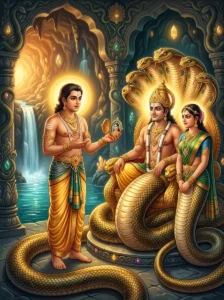
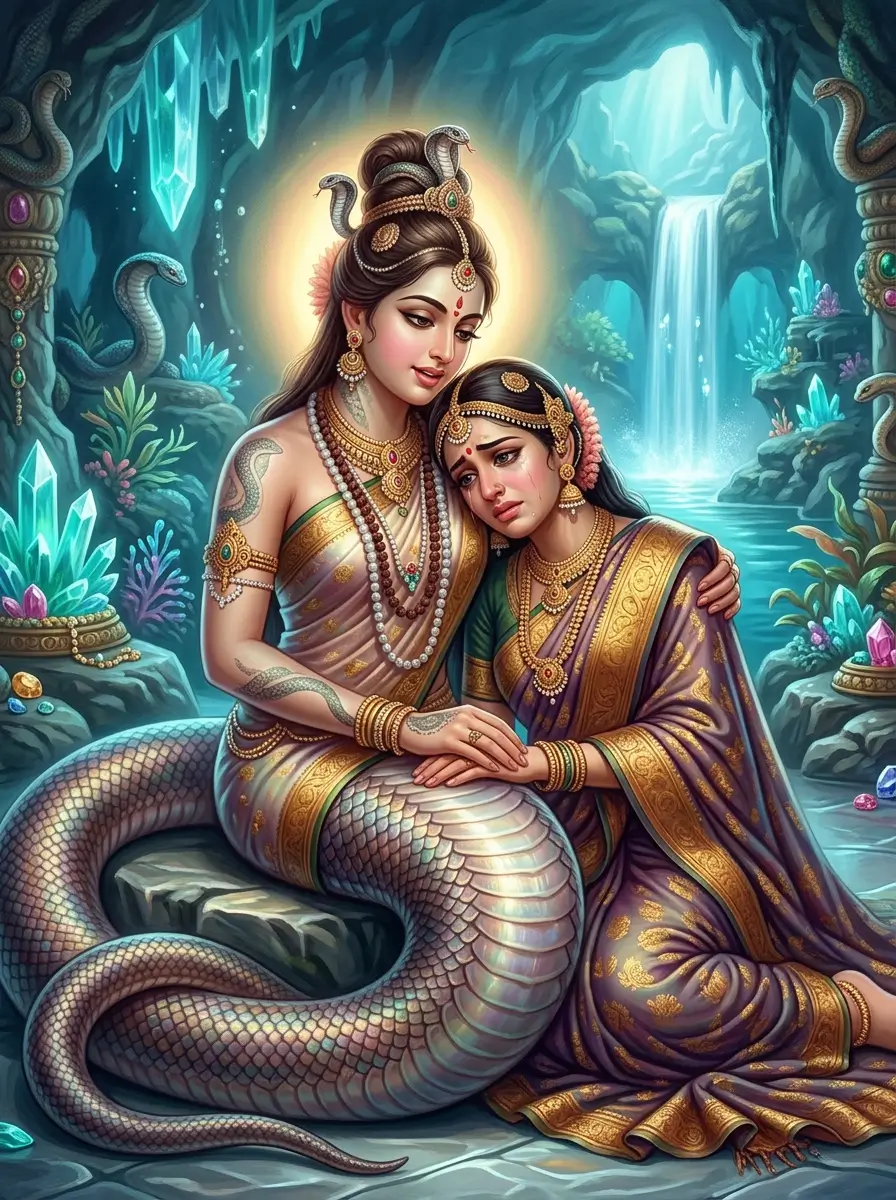
The ṛshi reassured the king that no wild beast or rākshasa had harmed Bahuḷā. He revealed that she was alive and residing in Rasātala, maintaining pure conduct. He then explained the extraordinary circumstances. A Nāgarāja named Kapotaka, dwelling in Pātāla, had spotted the beautiful and youthful Bahuḷā wandering alone in the great forest. Captivated by her appearance, he had conveyed her down to Pātāla. In the Nāgarāja’s household lived his wise daughter, Nandā, and his wife, Manoramā. Nandā, the Nāga princess, took Bahuḷā under her own protection, treating her as a companion and sheltering her in her personal quarters.
The Nāgarāja Kapotaka eventually came to Nandā and asked her to surrender the beautiful stranger. Nandā refused. Enraged, the Nāgarāja cursed his own daughter, declaring that she would become a mugdhā, one bereft of sense or awareness. It was because of this curse from her father that Nandā remained trapped in that state, and Bahuḷā, in turn, remained in Pātāla under Nandā’s care.
The Astrological Cause of Bahuḷā’s Hostility
The king then asked the ṛshi to explain why Bahuḷā, despite being loved by all the world, harbored no affection for her own husband. The ṛshi provided an astrological explanation. At the time of the vivāha, Ravi, Maṅgala, and Śanaiścara had cast their dṛshṭi upon the lagna. In Bahuḷā’s chart, Śukra and Bṛhaspati were present, but Candra and Budha stood in extreme mutual opposition. This planetary configuration was the root cause of the queen’s persistent hostility toward her husband. The ṛshi concluded by urging the king to return to his duties, govern by svadharma, and perform all dharmic kāryas together with his wife.
The Brāhmaṇa’s Gratitude and the Yajña
King Uttama returned to his capital and found the brāhmaṇa Viśāla happily reunited with his now virtuous wife. The brāhmaṇa praised the king as a true upholder of dharma. The king, however, lamented that his own home remained empty without Bahuḷā. The brāhmaṇa counseled the king against despair and offered a solution. He proposed to perform a yajña called Mātṛvandā, a rite designed to generate supreme affection in the heart of a hostile patnī toward her husband. Seven times the brāhmaṇa performed this ishṭi on behalf of the king, and when the great sage determined that Bahuḷā’s heart had at last turned toward her husband, he instructed the king to bring her back and enjoy married life together.
The Rākshasa’s Second Service
Astonished at this turn of events, the king recalled the rākshasa Balāka by thought alone. The moment the king remembered him, Balāka appeared, bowed, and asked what service was required. The king instructed him to descend into Pātāla and bring back Queen Bahuḷā. Balāka obeyed, traveled to Pātāla, retrieved the queen, and brought her before the king. Upon seeing her husband, Bahuḷā, her heart now transformed by the power of the yajña, addressed the king with tender words, repeatedly asking whether he was truly pleased with her. The king embraced her joyfully and assured her of his unwavering love.
Bahuḷā’s Request and the Liberation of Nandā
Bahuḷā then made a request. She told the king that the Nāga princess Nandā had been her protector and companion throughout her time in Pātāla, and that Nandā was still suffering under her father’s curse. She asked the king to find a way to free Nandā from the state of mugdhatā. The king turned to the brāhmaṇa Viśāla and asked what rite could accomplish this. Viśāla agreed to perform a Sārasvatī ishṭi. He began the yajña with great concentration, chanting the Sārasvatī sūktas. Through the power of this rite, the sage Garga, who dwelt in Rasātala, received the ability to speak and communicated with Nandā. The Nāga princess, learning that her friend Bahuḷā’s husband had accomplished this difficult act of upakāra on her behalf, was overjoyed. She immediately went to the queen, embraced her, and seated the king with honor.
Nandā’s Boon
Nandā, grateful and now freed from her affliction, addressed King Uttama with auspicious words. She declared that a son of immense vīrya would be born to him, one who would establish undivided sovereignty over the entire earth. This son, she prophesied, would be a master of all the śāstras, devoted to dharma, endowed with supreme buddhi, and destined to become the sovereign of an entire manvantara, reigning as Manu. Having bestowed this vara, Nandā embraced her friend Bahuḷā in a close farewell and departed for Pātāla.
The Reign of Auttama Manu
In due course, as King Uttama lived happily with Bahuḷā and governed his people with dharma, a son was born from the queen’s womb. The child possessed a radiance like that of the full moon on a Pūrṇamāsī night. At his birth, all the people rejoiced greatly, the Devas sounded their dundubhis, and a rain of flowers fell from the sky. The assembled sages, beholding the child’s brilliant tejas and discerning his future destiny, named him Auttama, meaning the son of Uttama. They declared that since Auttama was born in the lineage of Uttama, at an auspicious time, and was endowed with excellent limbs and qualities, the name Auttama was befitting.
The Deva Gaṇās
During the Auttama Manvantara, there were five gaṇas of Devas, each consisting of twelve deities, making sixty in total. The first gaṇa was known as the Svādhāmas, resplendent in their own tejas. The second gaṇa was called the Satyas. The third gaṇa bore the name Śivas, and it was said that merely remembering their name destroyed pāpa. The fourth gaṇa was known as the Pratardanas. The fifth gaṇa was called the Viśvarūtas, who were renowned for their illustrious forms and deeds. All five gaṇas were entitled to receive their share of yajña.
The Indra and Saptarshis
The Indra of the Auttama manvantara was named Suśānti. He had performed one hundred aśvamedha yajñas and thereby attained lordship over all the lokas. Even in subsequent ages, songs celebrating the glory of Suśānti continued to be sung across the earth. During the Auttama Manvantara, Suśānti, accompanied is by the Śiva, Satya, and other deva gaṇas, including the Viśvarūtas, ruled with brilliance and authority. The Saptarshis of this Auttama Manvantara were seven sons of the great tapasvī Vasishṭha, who had attained their positions through the power of their own tejas and tapas.
The Lineage
The Auttama Manu had three renowned putras, equal in fame to the Devas, named Aja, Paraśu, and Divya, all possessed of mahābala and parākrama. Throughout this period, the descendants of Auttama ruled the earth as righteous sovereigns.
Phalasruti of Auttama Manvantara
The sage Mārkaṇḍeya declared that whoever hears or reads the account of King Uttama’s life and the birth of Auttama Manu will never encounter enmity or sorrow. Such a person will never suffer separation from loved ones, whether ishṭas, putras, bhāryā, or bandhus. So is the wonderful story of how Auttama Manu came into being.