
Madālasā Upākhyāna
The Madālasā Upākhyāna is an ancient narrative found within the Mārkaṇḍeya Purāṇa that delineates the paths of worldly duty and spiritual liberation. The story details the life of the Gandharva princess Madālasā, her marriage to King Ṛtadhvaja, and her role as a spiritual guide for her husband and children. It is particularly noted for the cradle songs through which Madālasā imparted metaphysical wisdom to her sons, leading most of them to choose the path of a yogī.
Rescue of Madālasā and Early Reign
The narrative begins with the reign of King Śatrujit and his valiant son, Ṛtadhvaja, who was also known as Kuvalayāśva. The prince acquired the name Kuvalayāśva after receiving a celestial horse named Kuvalaya from the sage Gālava, which possessed the power to traverse the sky and the netherworld. Tasked with protecting the hermitage from a demon named Pātālaketu who disrupted Vedic sacrifices, Kuvalayāśva pursued the demon into a deep chasm that led to Pātāla. In the netherworld, he discovered the beautiful Madālasā, daughter of the Gandharva king Viśvāvasu, who had been abducted by the demon. With the help of the priest Tumburu and the guidance of Madālasā’s companion Kundalā, Kuvalayāśva defeated Pātālaketu and married Madālasā according to the Gandharva rites.
The Deception of Tālaketu and Death of the Queen
While the couple lived happily in the capital, the brother of the slain demon, Tālaketu, orchestrated a deceptive revenge. Tālaketu appeared before Ṛtadhvaja in the guise of a sage and requested the prince to guard his hermitage while he performed a ritual in the river. During the prince’s absence, Tālaketu visited the palace and falsely informed Madālasā that Ṛtadhvaja had been killed by demons. To prove his lie, he presented Ṛtadhvaja’s own ornaments, which he had obtained through guile. Overwhelmed by grief, Madālasā immediately abandoned her physical body through the power of her devotion. When Ṛtadhvaja returned and learned of his wife’s death, he was devastated but resolved to remain a celibate widower, honoring her memory for the rest of his life.
Rebirth and Restoration
The Naga princes Aśvatara and Kambala, who were close friends of Ṛtadhvaja, sought to alleviate the king’s suffering. Their father, the Naga king Aśvatara, performed intense penance to the goddess Sarasvatī to master the art of music, which he then used to please the god Śiva. As a boon, Aśvatara requested that Madālasā be reborn as his daughter, possessing the same form and memories of her previous life. Madālasā was thus restored to the world as a Jātismara, one who remembers past births. Eventually, Aśvatara invited Ṛtadhvaja to Pātāla and presented the resurrected Madālasā to him, reuniting the couple.
The Spiritual Education of the Sons
Upon Ṛtadhvaja ascension to the throne, Madālasā gave birth to three sons named Vikrānta, Subāhu, and Śatrumardana. Unlike traditional royal upbringing, Madālasā sang to them in their cradles, teaching them that they were pure, enlightened, and stainless souls. She instructed them that the physical body was merely a garment composed of elements, and that worldly relationships were illusory. Consequently, all three sons developed complete detachment and renounced the kingdom to pursue Nivritti, the path of renunciation. When the fourth son, Alarka, was born, Ṛtadhvaja intervened and insisted that Madālasā raise him to be a king who would fulfill his social and religious obligations. Madālasā complied, instructing Alarka in Rājadharma, Gṛhastha duties, and the importance of protecting the subjects.
The Trial and Enlightenment of Alarka
Before Ṛtadhvaja and Madālasā retired to the forest for the Vānaprastha stage, she gave Alarka a golden ring containing a scroll to be read only in times of extreme distress. Alarka eventually became king and ruled with great virtue, yet he remained deeply attached to his palace and kingdom. Observing this, his brother Subāhu conspired with the King of Kāśī to seize Alarka’s territories, intending to force Alarka toward liberation. Faced with the loss of his army and treasury, Alarka consulted the scroll, which advised him to seek the company of the wise. He approached the sage Dattātreya, who provided a profound discourse on the distinction between the self and the non-self. Dattātreya explained that suffering arises from the concepts of I and mine, and he taught Alarka the practice of Yoga to achieve mental stillness. Following these teachings, Alarka attained Ātma-jñāna, gave the kingdom to his son, and achieved final salvation.
Essence of Madālasā Upākhyāna
Philosophies of Pravṛtti and Nivṛtti
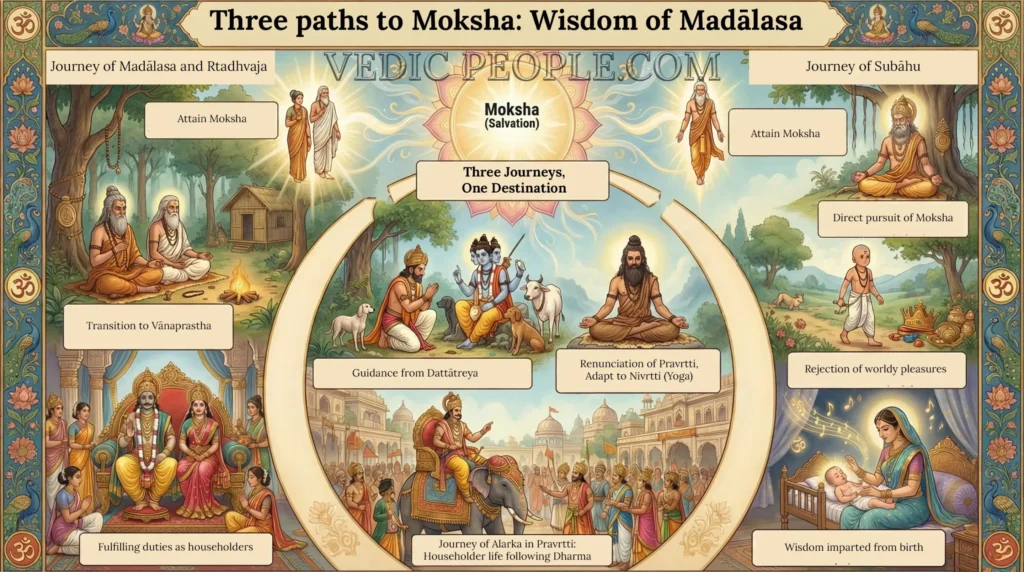
The Madālasā Upākhyāna presents a comprehensive view of human life by contrasting the path of action known as Pravṛtti and the path of renunciation known as Nivṛtti. Pravṛtti involves the fulfillment of social and religious duties through the Varṇāśrama system, specifically focusing on the householder stage or Gṛhastha. Nivṛtti is characterized by the withdrawal from worldly ties and the focused pursuit of self-realization or Ātma-jñāna. The narrative affirms that both paths are valid means to reach the ultimate goal of Moksha, provided the individual acts according to their inherent nature and specific duties.
Exclusively Nivṛtti Path of Subāhu
Subāhu and his elder brothers Vikrānta and Śatrumardana illustrate the path of immediate Nivṛtti. From their infancy, Madālasā sang to them that they were pure, enlightened, and free from the limitations of the physical body. By teaching them that the physical form is merely a kanchuka or garment and that social relations are temporary constructs, she enabled them to bypass the householder stage entirely. These sons developed total detachment and pursued the path of a yogī from their youth, demonstrating that for those with clear understanding, the cycle of worldly experience can be transcended immediately. Subāhu later returns to challenge his brother Alarka not out of greed, but as a spiritual provocateur to help Alarka break his own attachments.
Integrated Path of Alarka and the transition to Nivṛtti
Alarka serves as the primary example of an individual who achieves liberation after first fulfilling a life of Pravṛtti. At the request of his father Ṛtadhvaja, who desired an heir to maintain the royal lineage, Madālasā directed Alarka toward the duties of the Gṛhastha and the responsibilities of a monarch. She taught him that the householder provides the essential support system for all other stages of life and that a king must protect his subjects and uphold justice while remaining mentally detached. Alarka ruled his kingdom with great virtue for many years before he began to suffer from the burden of deep worldly attachment. Following the instructions provided in his mother’s ring and the subsequent guidance of the sage Dattātreya, he transitioned to Nivṛtti in mid-life. His journey proves that the experience gained in the world can serve as a catalyst for spiritual awakening when the role of the householder is performed without ego.
Varṇāśrama Completion of Madālasā and Ṛtadhvaja
Madālasā and Ṛtadhvaja themselves model the path of fulfilling the entire cycle of Varṇāśrama dharma through all designated stages. As a king, Ṛtadhvaja protected the dharma of his subjects and performed numerous sacrifices as required by his royal status. Madālasā acted as a devoted wife and a wise spiritual guide, using her insight as a Jātismara to fulfill her social roles while remaining internally liberated. After their responsibilities were met and their children were settled, the couple transitioned to the Vānaprastha stage, retiring to the forest to practice austerities and meditation. By living through the successive stages of student, householder, and forest dweller, they demonstrated a holistic approach where worldly life is utilized as a school for the soul before the final withdrawal to achieve Moksha.