Itihāsas
Itihāsa · iti-ha-āsa, “thus indeed it was”
The Itihāsas are the two great epics of Sanātana Dharma: the Rāmāyaṇa and the Mahābhārata. The word itihāsa means “so indeed it happened.” Tradition treats them as accounts of real events, told in a way that teaches dharma.
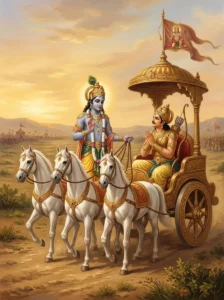
The Rāmāyaṇa tells the life of Śrī Rāma: his exile to the forest, the abduction of Sītā by Rāvaṇa, and the war in Laṅkā. The Mahābhārata tells of the war between the Pāṇḍavas and the Kauravas. It includes the Bhagavad Gītā, the teaching of Śrī Kṛshṇa to Arjuna on the battlefield.
The Rāmāyaṇa
The Rāmāyaṇa was composed by the ṛshi Vālmīki. It has about 24,000 ślokas in seven books called kāṇḍas. It is honoured as the ādi-kāvya, the “first poem.” Through the life of Śrī Rāma it shows what it means to be an ideal son, brother, husband and king.
The Mahābhārata
The Mahābhārata was composed by Veda Vyāsa. It has about 100,000 ślokas in eighteen books called parvas, which makes it one of the longest poems in the world. Around its main story it gathers hundreds of older stories and teachings on dharma, kingship and moksha. For this reason it is often called the fifth Veda.
The Itihāsas and the Purāṇas
An Itihāsa follows one main story from beginning to end. A Purāṇa ranges more widely: it tells of creation, the ages of time, the lineages of kings and ṛshis, and the deeds of the devas. The two support each other, and the same people often appear in both.
The Itihāsas in the Bhāgavata Purāṇa
When King Parīkshit asked Śrī Śuka Maharshi to teach him all the Bhāgavata, he asked, among much else, to hear the nature of the Vedas, the Upavedas, the Dharmaśāstras, the Itihāsas and the Purāṇas.
When Bhagavān Vishṇu as Trivikrama raised his foot to Satyaloka, those who dwell there in embodied form came forward and bowed to it: the Vedas, the Upavedas, the yamas and niyamas, Nyāyaśāstra, the Itihāsas, the Vedāṅgas, the Purāṇas and the Saṃhitās.
Source: Bhāgavata Purāṇa, Skandha 2, Chapter 8; Skandha 8, Chapter 21
On this website
Both epics have been retold many times, in Sanskrit and in the regional languages of India. This section begins with the Rāmāyaṇas.
Sources
- Bhāgavata Purāṇa, Skandha 2, Chapter 8; Skandha 8, Chapter 21