Kapotaka, A Nāga King
|
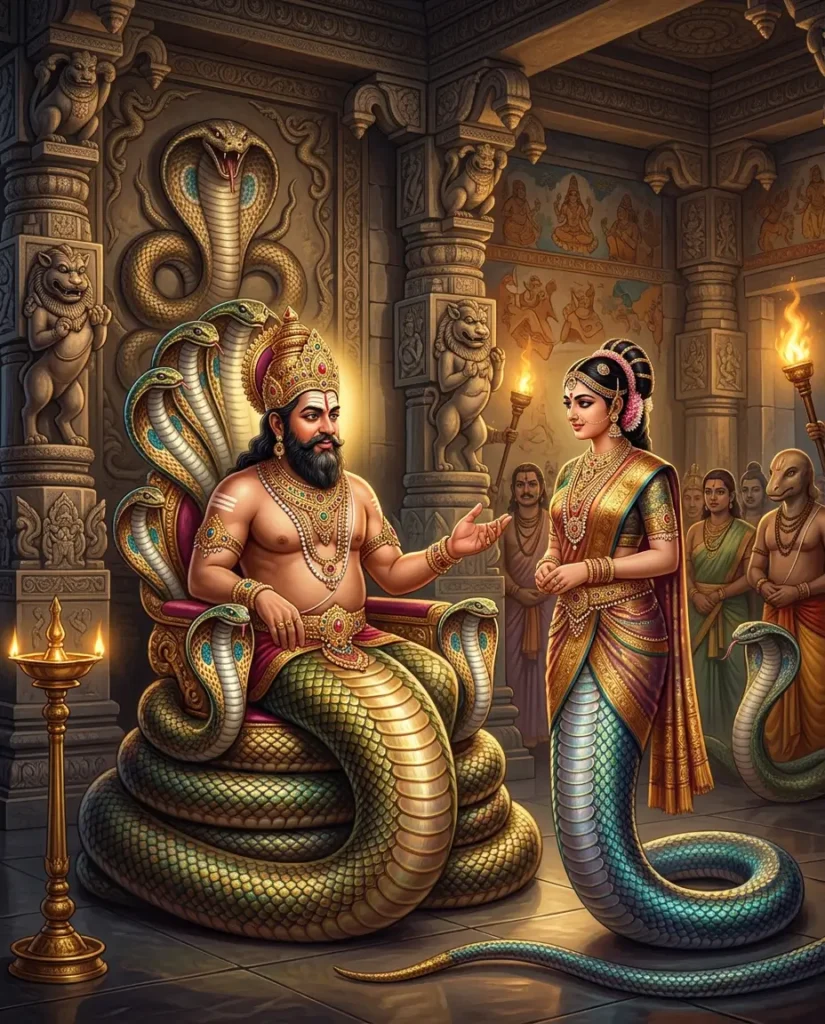
Kapotaka was a celebrated Nāgarāja (Serpent King) who resided in Pātāla. He is remembered in the sacred narrative preserved within the Mārkaṇḍeya Purāṇa, specifically within the episodes recounting the Vaivasvata Manvantara. Though he appears briefly in the narration, his role is pivotal: it was his deep affection for a beautiful woman – the abandoned wife of a brāhmaṇa -that set in motion a chain of events connecting dharma, karma, śāpa, and ultimately redemption. His story is documented here as it was narrated by the ṛṣi Mārkaṇḍeya.
Kapotaka was a nāga, a serpent being of great power and intelligence, renowned throughout Pātāla. He was widely known as a nāgarāja, which is to say he held the status of a king among the nāgas. His home was in Pātāla, the subterranean realm beneath the earth. He had a daughter named Nandā and a wife named Manoramā.
His Encounter with the Brāhmaṇa’s Wife
Once, Kapotaka came up from Pātāla and was moving through a great forest. There, he noticed a young woman of remarkable beauty who had been wandering alone. She turned out to be the wife of a brāhmaṇa – a woman who had been abandoned by her husband, the king Uttama, son of Uttānapāda, following a period of estrangement brought about by the workings of karma from a past life.
Kapotaka was struck by deep affection for this woman. He expressed his feelings to her and, taking her with him, descended with her into Pātāla. Once there, his daughter Nandā took charge of the woman, treating her as she would treat her own mother, and sheltered her within the inner chambers of their home, keeping her safe and well looked-after.
The Curse Upon Nandā
After the brāhmaṇa’s wife had been brought into their home, Kapotaka himself approached his daughter Nandā and expressed his desire for the woman – that is, the same woman Nandā had been caring for. Nandā, however, refused to comply with her father’s wish. She did not agree to hand the woman over to him.
Enraged by this refusal, Kapotaka cursed his own daughter Nandā. He said to her, in his anger, that she would become a human being – or words to the effect that a consequence would befall her for defying him. This curse as the direct result of Nanda’s refusal to obey her father’s demand and became one of the significant outcomes of Kapotaka’s conduct.
His Role in Restoring the Brāhmaṇa’s Wife
The brāhmaṇa’s wife remained in Pātāla under Nandā’s protection. Meanwhile, the rākṣasa who had originally abducted the woman – at the behest of external circumstances tied to the brāhmaṇa’s own karma – had brought her into the forest. In the sequence of events that followed, King Uttama, acting on guidance received from the great ṛṣi he visited in the forest, eventually learned where his wife was.
The ṛṣi, who possessed complete jñāna of past, present, and future – knowledge conveyed to him through his śiṣya – revealed to King Uttama that his wife had been taken by Kapotaka the nāgarāja into Pātāla, and that she was now residing there under the care of Nandā, Kapotaka’s daughter. Through this divine knowledge, the king came to understand the full truth of what had happened to his wife and where she could be found.
Significance in the Uttama Manvantara
Kapotaka’s actions, while driven by desire and followed by anger, ultimately became part of a larger unfolding of karma. The brāhmaṇa’s wife herself, when she was finally reunited with the king, declared that the rākṣasa was merely the instrument of events, and that neither the rākṣasa nor her husband bore the real fault – the suffering she had undergone was the fruit of her own karma from a previous birth. By extension, Kapotaka’s role as the one who brought her to Pātāla was also part of this karmic unfolding.
His daughter Nandā, despite receiving a śāpa from her own father for protecting the woman, is portrayed as acting rightly. Kapotaka himself, though he displayed both affection and anger, is recorded in the narrative without further elaboration of his ultimate fate. The narration closes on his role as the one through whose household the brāhmaṇa’s wife was sheltered in Pātāla, until the circumstances of dharma brought about her restoration to her rightful place.
Source: Mārkaṇḍeya Purāṇa, Chapter 66 – 70